
The Cropwalker - Volume 9 Issue 10

By Jonathan Zettler CPA, CMA, CCA-ON and Patrick Lynch CCA-ON
ALWAYS READ AND FOLLOW LABEL DIRECTIONS
CONFIDENTIAL NOT FOR PUBLICATION
Send us your questions
If you have a question, just reply to this email, we try to have an answer for you within 48 hrs. Or text Jonathan at 519 323 7505 or Patrick at 519 275 1058. If you want a topic researched let us know.
Unable to see pictures? Move this email to your inbox or ask your email app to download them. Usually at the top of the email in a header.
Things to do This Week
1. Drive by any winter cereal fields to check for winterkill
2. Check your “as applied” planting/spraying/fertilizing data from 2025. Need to make changes on the monitor/planter setup for the 2026 season? See article below for reference.
3. Take stock of your old stock crop protection inventory and share it with whoever makes the buying/recommendation decisions to get it used up.
Weed Control
Winter Wheat Herbicides (JZ & PJL)
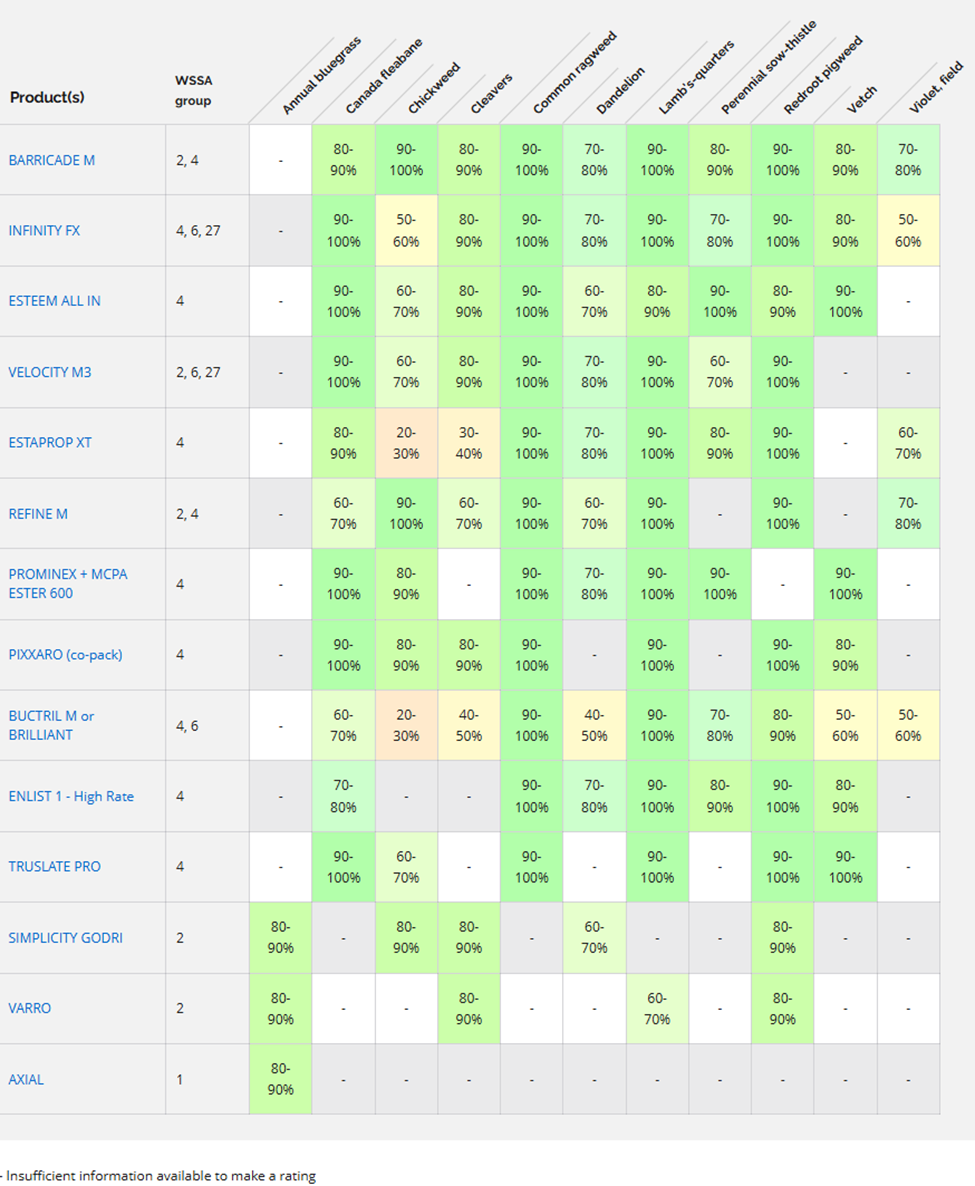
When it comes to winter wheat the herbicide performance is really categorized based on their ability to control maybe 4 groups of weeds - Winter annuals, fleabane, perennial broadleaves, and annual broadleaves. Almost all of these herbicides will control annual broadleaves without too much issue. This means the driver weeds of which product to pick comes down to the other three weed categories.
Winter annuals – chickweed, cleavers, speedwell, field violet etc. – generally these weeds need products that contain fluroxypyr or Refine M or Barricade M to control them.
Fleabane – Many options on the market to control fleabane in wheat, most are 2,4-D based, or contain fluroxypyr and/or clopyralid.
Perennial Broadleaves – Sowthistle, Canada Thistle, Tufted Vetch, Dandelions – most effective products contain fluroxypyr and/or clopyralid. Typically, when you apply your winter wheat herbicide perennial broadleaves have not emerged enough to achieve significant control
The chart below shows options. If you want me to make a chart for you, send me your weeds (PJL)
Q – Jonathan, what are your main non-gmo soybean pre-emerge programs? (JZ)
A – Here are my top three recommended programs (in no particular order). My target weeds are lamb’s quarters, pigweed, ragweed, nightshade and fleabane.
1. Boundary + Authority or Strim MTZ + Authority – has been consistent, it can be weak on ragweed if you do not top up the metribuzin. Be ready to come back with Reflex if ragweed escapes.
2. Bifecta + Zidua – Best on fields with ragweed, higher risk of crop injury on clay soils.
3. Authority Supreme + metribuzin (Sencor 480/Tricor LQ) – stronger than Boundary on bluegrass, more control over metribuzin rate if adjusting for soil type.
4. Authority Supreme + Conquest LQ – If you have a dog’s breakfast of weeds I have used this mix on the toughest weed control fields with very good success. I had been keeping this program a secret in Jonathan’s tool box, but perhaps it is time to share it.
Soybeans
Double Crop Soybeans (PJL)
A reader commented on an article In Ontario Farmer where Horst Bohner (OMAFA) reviewed some trials he called double cropped soybeans. Yields were impressive for planting at Elora on July 11. BUT these were not double cropped. After the land lay unused throughout the spring, they were planted. Do not expect to harvest wheat in Elora area early enough to plant soybeans on July 11. Also, the limiting factor with double crop soybeans is available moisture. Elora obviously had good moisture after planting.
JZ – could maybe have Winter Barley off by July 11th to get in double crop soybeans at Elora.
Forages
The following I have taken from Francis Kilcer Certified Crop Advisor in New York March Newsletter (PJL)
A key step in harvesting very high-quality winter forage is to use the wide swath same day haylage techniques. Four or five cuttings of alfalfa will give 3.5 to 4.5 tons of dry matter over a season. Mowing forage directly to a windrow and letting it sit for 3 – 4 days will very efficiently “windrow compost” and remove digestible energy. Adding insult to injury, the complete sugar loss means that Clostridia will tear apart the protein molecule and produce rotten forage of high butyric content. Not something to feed cows to make profitable milk. You are using the very efficient and proven PHOTOSYNTHETIC DRYING to reduce forage moisture. This is where the leaves are kept in the sun, so photosynthesis simultaneously dries the crop and increases the digestible components of the forage. With a wide swath, same day haylage, we have dried high yields to over 30% dry matter in just a few hours. There are no shortcuts, and skipping steps will ensure you have a forage wetter than you would like. First step is to remove all shields so the mower leaves a swath a minimum of 85% of the original cutter bar width. Leaving the flexible “lawyer shields” hanging down on the back will ensure your swath is a line of large lumps that do not dry. Raising or removing these will allow the forage to feed out uniformly and in a very porous swath with maximum sun exposure. Ironically, the gold standard is a side bar sickle that cuts and drops the swath in the same width, resulting in leaves on the top and the stems on the bottom. Nearly the same can be accomplished by disk mowers, especially those with flat knives. The more twist to the knife, the more milk-robbing ash in the forage, and the more the paired drums produce an inefficiently dried windrow instead of a swath.
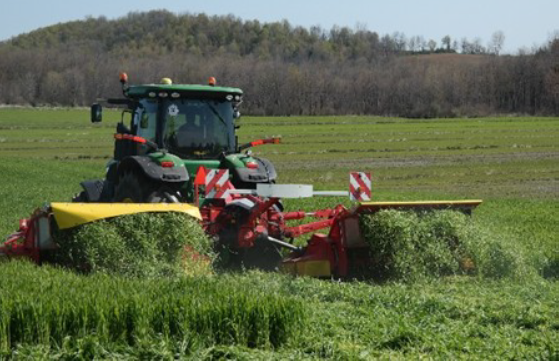
Yellow shield on the left catches mowed forage and drops it in a non-drying lump. Raising the shield on the right allows the forage to flow through unimpeded and fall in a loose porous uniform swath
CONDITIONING IS COUNTERPRODUCTIVE AND SLOWS DRYING when using photosynthesis. The leaves use moisture to produce sugars. They draw more moisture from the stems, which draws air into the bottom of the stem, drying it first. Conditioning is like kinking a copper pipe; it stops water flow to the leaves and reduces the drying rate. Tine conditioners are a horror show, removing the nutritional leaves.
I asked Kilcer about layer shields and snow mould. His comments (PJL)
The layer shield is the tarp or deflector at the back of the machine where the forage comes out. They deflect the forage down and put it into non drying piles. The original name came from stopping stones from going through the neighbor’s windows when mowing.
Bronco and Snow Cat are Canadian varieties advertised as snow mold resistant. I don’t have comparisons yet. I told the head breeder of the largest triticale seed supplier down here that snow mold resistance needs to be his #1 breeding target.
We have sprayed in the fall, just before snow, with a sulfur fertilizer. We have used Max-N, a sulfur fertilizer 0-0-0-19S, sprayed in late November, and had excellent results to the point that a round patch of snow mold was cut off right where the sprayer had passed, and there was no snow mold. I would apply it to any flat part of a field where water will pond on frozen ground. (JZ - It is legal to foliar fertilize with sulfur.) Some companies have come out with a snow mold fungicide, but I have not had a chance to test them.
Planting too early and too much top growth has little to no impact on snow mold – from multiple replicated research plots.
Fertility
Nitrogen Products and Nitrogen Cycle (JZ)
The nitrogen cycle in crop production often begins with urea fertilizer applied to the soil surface.
Urea → Ammonium (NH₄⁺) occurs through a process called hydrolysis. At this stage, nitrogen is at risk of volatilization, where ammonia gas is lost to the air, especially on warm, moist, high‑pH soils.
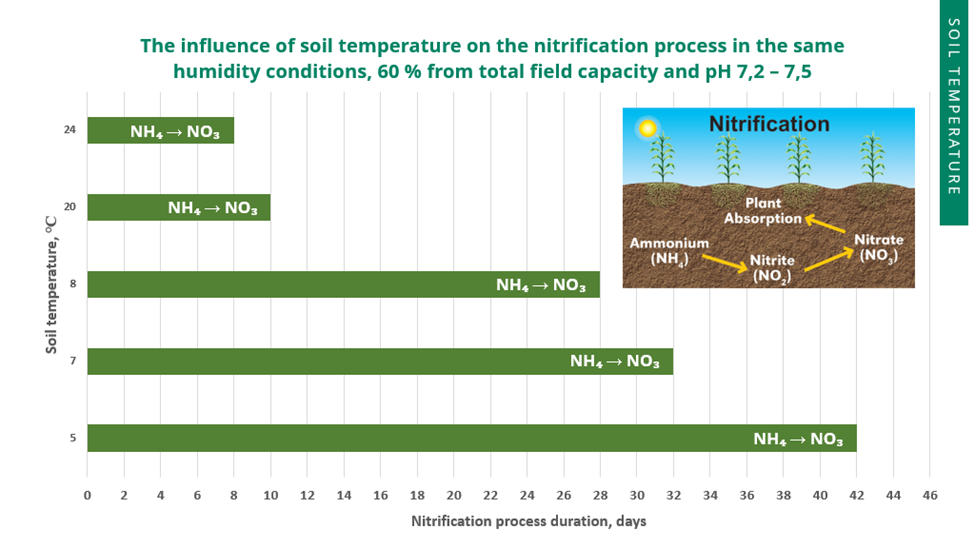
Next, soil bacteria convert ammonium into nitrate through nitrification:
Ammonium → Nitrate (NO₃⁻). Ammonium is relatively stable because it can attach to soil particles, but once it becomes nitrate, nitrogen is more mobile.
Nitrate → Plant Uptake happens as roots absorb nitrate for growth and protein formation. However, nitrate is vulnerable to leaching with excess rainfall on sandy soils and denitrification in saturated soils, where bacteria convert nitrate into nitrogen gases.
Managing timing, placement, and inhibitors helps reduce losses and improve nitrogen efficiency.
Nitrogen Losses in Field Crops: Where, When, and How to Reduce Them (JZ)
Nitrogen is essential for crop growth, but it can be lost from the soil through denitrification, leaching, and volatilization. These losses depend on soil type, landscape position, weather, and the form of nitrogen applied.
Denitrification occurs when nitrogen is in the nitrate (NO₃⁻) form and soils are saturated with water. This loss is most common in low-lying areas, depressions, clay soils, and poorly drained fields. After 25–50 mm of rainfall or several days of ponding, and when soil temperatures are above 10°C, soil bacteria convert nitrate into nitrogen gases that escape into the air. Nitrification inhibitors such as nitrapyrin or DCD (dicyandiamide) help reduce this loss by slowing the conversion of ammonium to nitrate, keeping nitrogen in a more stable form during wet periods.
Leaching also requires nitrogen to be in the nitrate (NO₃⁻) form. It is most likely on sandy or coarse-textured soils, upper slopes, and areas with good drainage. Heavy rainfall or snowmelt over 50 mm, especially early in the season before roots are deep, can move nitrate below the root zone. Nitrification inhibitors (nitrapyrin or DCD) help by delaying nitrate formation until crops can better use the nitrogen.
Volatilization happens when nitrogen is applied as urea or ammonium (NH₄⁺) and remains on the soil surface. This is common on high-pH soils, no-till fields, crop residue, and knolls or hilltops. Warm temperatures above 15°C, moist soils, and wind increase losses as ammonia gas. Urease inhibitors, most commonly NBPT, slow the breakdown of urea and reduce volatilization until rainfall or incorporation moves nitrogen into the soil.
Matching nitrogen source, inhibitor, soil type, and landscape position helps protect yield and fertilizer investment.
Running Nitrogen Inhibitor Trials (JZ)
Nitrogen inhibitors cannot improve yield; they can only protect against nitrogen losses. If you are applying rates well beyond what is agronomically required in spite of losses, then you are unlikely to see a response to the addition of a nitrogen inhibitor. The 2nd piece is only use inhibitors when you have the risk of loss, you do not want to limit nitrogen availability when the plant might be looking for it. In my opinion we need to be cautious to the type of N losses when we are using inhibitors with growing crops like winter wheat. The use of these products can prevent nitrogen from being available at key times, reducing yield. Look at crop stage, N demand and risk of loss before blindly applying a nitrogen inhibitor.
Unsure if these products are a fit on your operation? I would suggest making a few passes with and without these products the length of the field through multiple landscape positions. Not all landscape positions will respond equally when it comes to nitrogen losses.
What is in a nitrogen rate? (JZ)
If you are having to run much higher rates of nitrogen to get the same yield response as your neighbours, there could be a few reasons.
1) You are applying more than agronomical required
2) Your method of application prevents plant up take at the appropriate time
3) You have had N losses at much higher rate than expected
4) Something else in your management (i.e., crop rotation/placement/etc.) is causing you to require additional N Loss – excessive N rates to get yields, likely have some nitrogen losses
Precision Ag
Look-Ahead – A Pet Peeve When It Comes to Rate Controllers/Monitors (JZ)
You spend the money on the management zones/high resolution field data. You spend the money on the prescription writing and check blocks. You apply the prescription to the field after learning how to import the data and get the rate controller to read the file… only for the monitor look-ahead to be set up improperly, leading to poor application quality.
As someone that spends considerable time writing prescriptions and analyzing prescriptions, I am pleading with you to properly setup your monitors when you are heading to the field and ensure that the “lag factor” in your monitor is setup properly when it comes to applying your target seeding, spraying or fertilizer rate. Everything else can be completed properly in the process but if this step is not taken care of, you end up with the wrong rates being applied in zones and almost impossible to measure check blocks when it comes to evaluating the final data.
Why is this adjustment on the monitor in the first place? The GPS beacon reads the location of the rate to be applied, and each machine has some nuances when it comes to applying the rate (distance between seed tube and beacon, length of tongue, ground speed etc.), that cannot always be accounted for, so there is adjustment factor available to the machine operator. How do you know your look ahead is properly setup? The applied data when the zones change will line up square from pass to pass and not be jagged from one pass to the next.
If you have played around with the look ahead factor and are still having issues, common issues customers have reported to me are: software updates that needed to be completed, poorly setup hydraulics, something broken mechanically (i.e. hydraulic pump, poor chains).
Weather Data
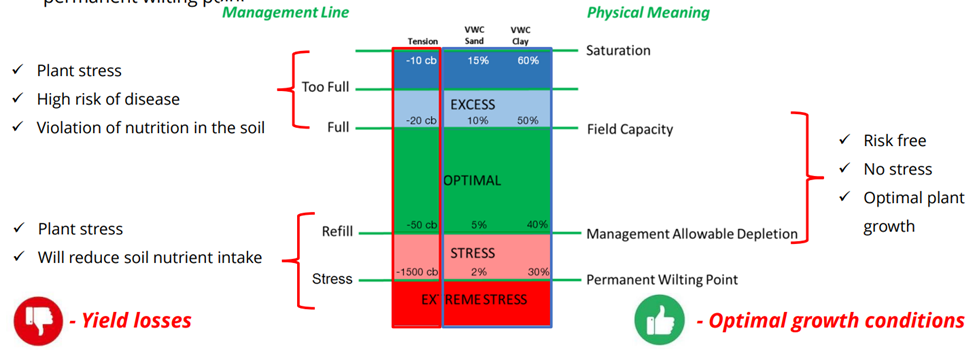
Water Availability by Soil Type (JZ)
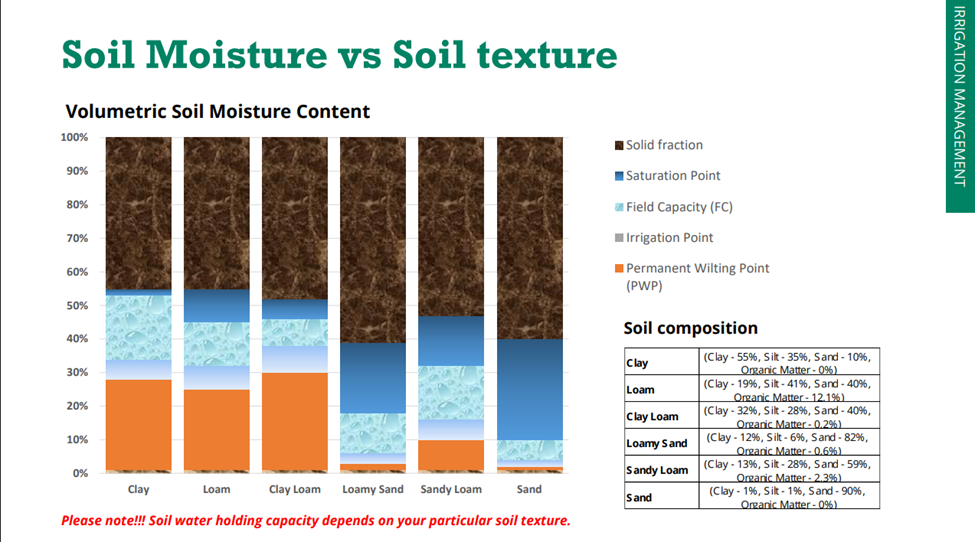
· Field Capacity is the amount of soil moisture or water content held in the soil after excess water has drained away and the rate of downward movement has decreased
· Saturation - If all soil pores are filled with water the soil is said to be saturated
· Permanent Wilting Point (PWP) - The soil water content at the stage where the plant dies, is called permanent wilting point
Business Matters
What would you rather have? Cheap inputs or High crop prices? (JZ)
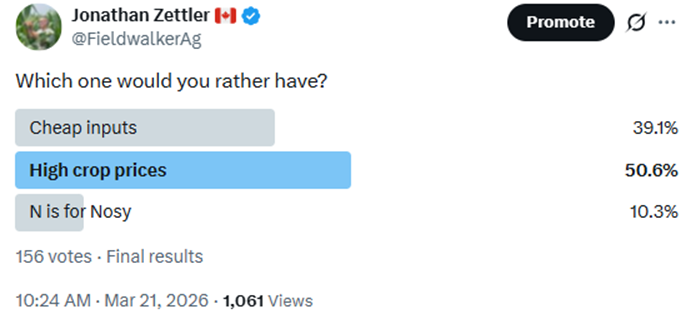
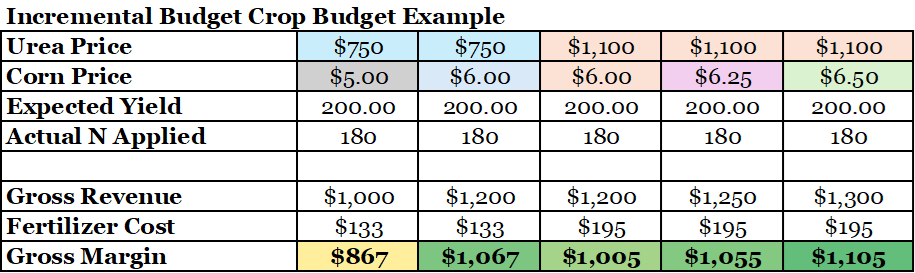
Two scenarios to keep in mind when doing crop budgets. Which would you rather have?
It's only by saying NO that you can concentrate on the things that are really important.
-Steve Jobs