
The Cropwalker - Volume 9 Issue 11

By Jonathan Zettler CPA, CMA, CCA-ON and Patrick Lynch CCA-ON
ALWAYS READ AND FOLLOW LABEL DIRECTIONS
CONFIDENTIAL NOT FOR PUBLICATION
Send us your questions
If you have a question, just reply to this email, we try to have an answer for you within 48 hrs. Or text Jonathan at 519 323 7505 or Patrick at 519 275 1058. If you want a topic researched let us know.
Unable to see pictures? Move this email to your inbox or ask your email app to download them. Usually at the top of the email in a header.
Crop Conditions
Winter wheat nitrogen application has started with some areas 5-10 % of the acres receiving the first application. More acres will be done this week as ground dries. If there is a little snow in some areas don’t worry just “get er done”. Winter kill is minimal. However, we can lose acres in April. Forages are starting to green up.
Things to do This Week
1. A small window to get someone to soil test fields that have not been tested in 3 years.
2. Good week to calibrate sprayer.
3. Figure out all spray mixes. Amount of water and amount of each product in a tank mix. Write this down and have ready for anyone to check.
4. Check forage fields for winter survival tile blowouts and any big stones that need picking.
5. Gather up last years seed and decide where to plant it. Old seed may lose some vigour so do not plant it first but make sure it gets planted. With old forage seed consider mixing it with this year’s seed.
6. Check all fire extinguishers.
7. Check SMV signs so that they are secure and visible.
Cereals
Q What seeding rate of Spring Wheat should I plant? (JZ)
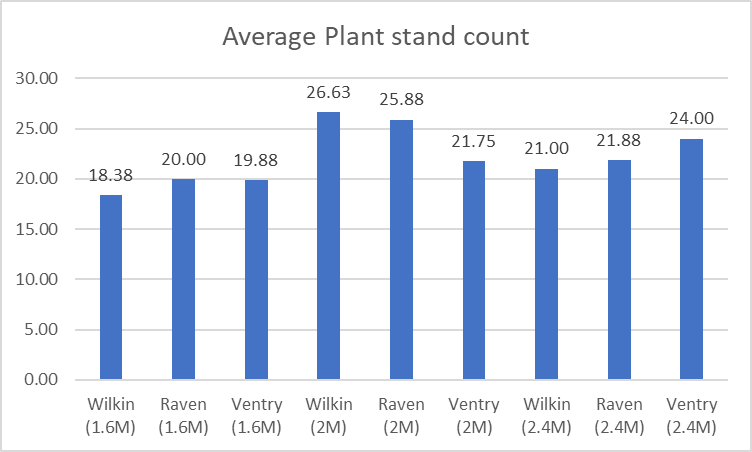
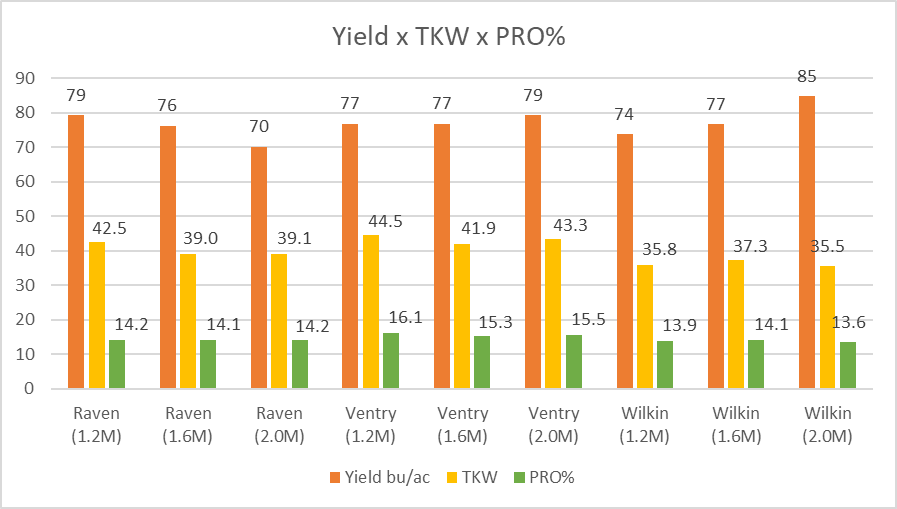
I worked with C&M Seeds in 2023 to run a variety by population trial. This is what we found. I am working on trying to understand phenology (yield components and how they are influenced by management (seed rates)) in the field crops I work with and see if there is variety difference. This is critical in understanding plant behaviour if you are wanting to work with variable rate seeding.
A few comments.
There did seem to be higher seed mortality at the higher populations, even though the plots were randomized. Some varieties respond better to increased seeding rates than others. Wilkin has very stable Thousand kernel rate regardless of seeding rate.
N use goes hand in hand with fungicide use (JZ)
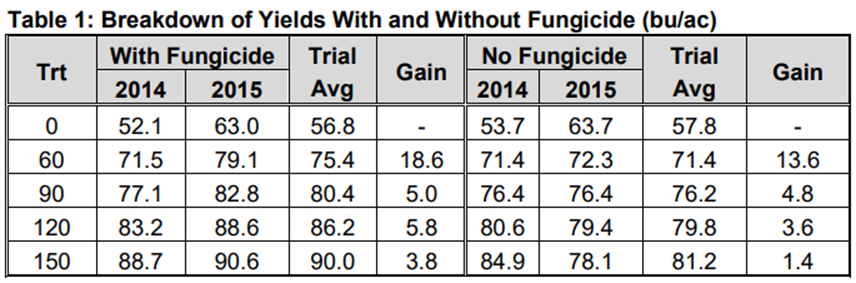
When it comes to helping customers figure out their nitrogen rate, my first comment is usually to ask what their fungicide use is and what variety are they growing. Increasing N rate without the use of fungicides will result in a lower yield response versus adding a 2-pass fungicide program. See WheatPete’s data below.
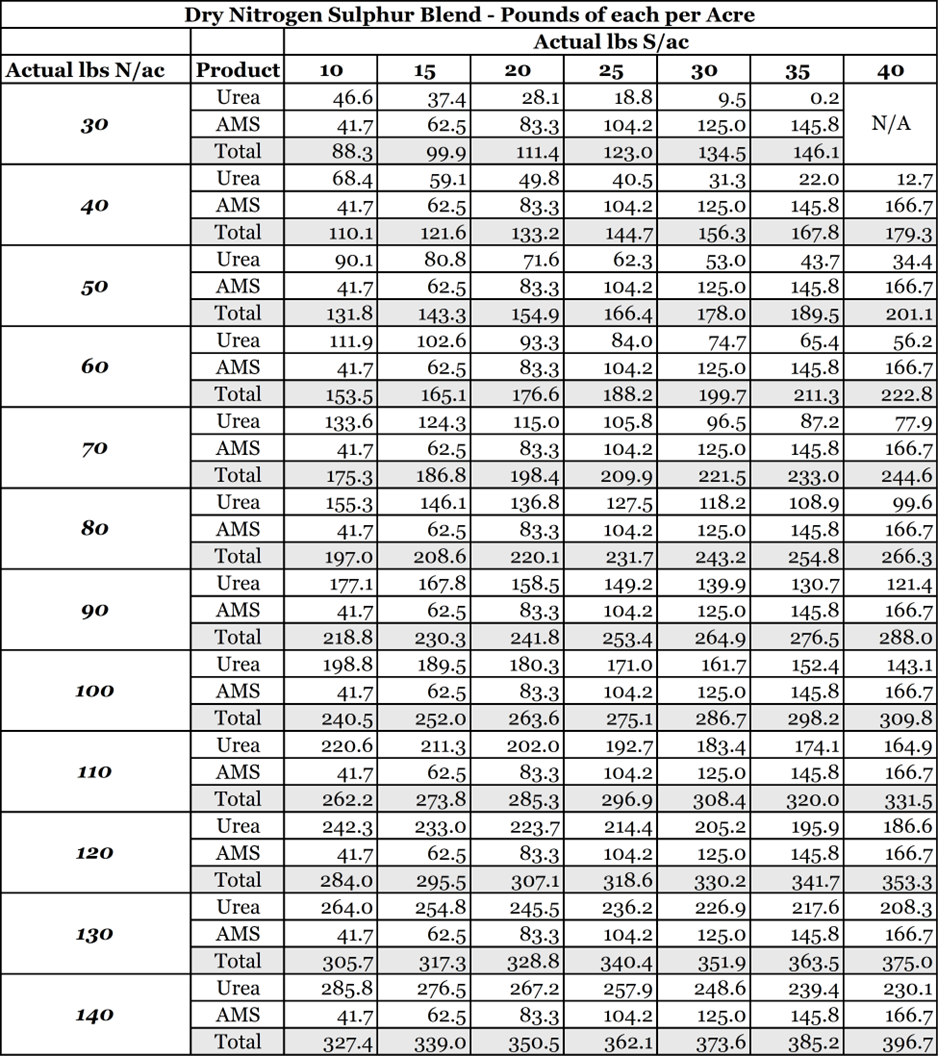
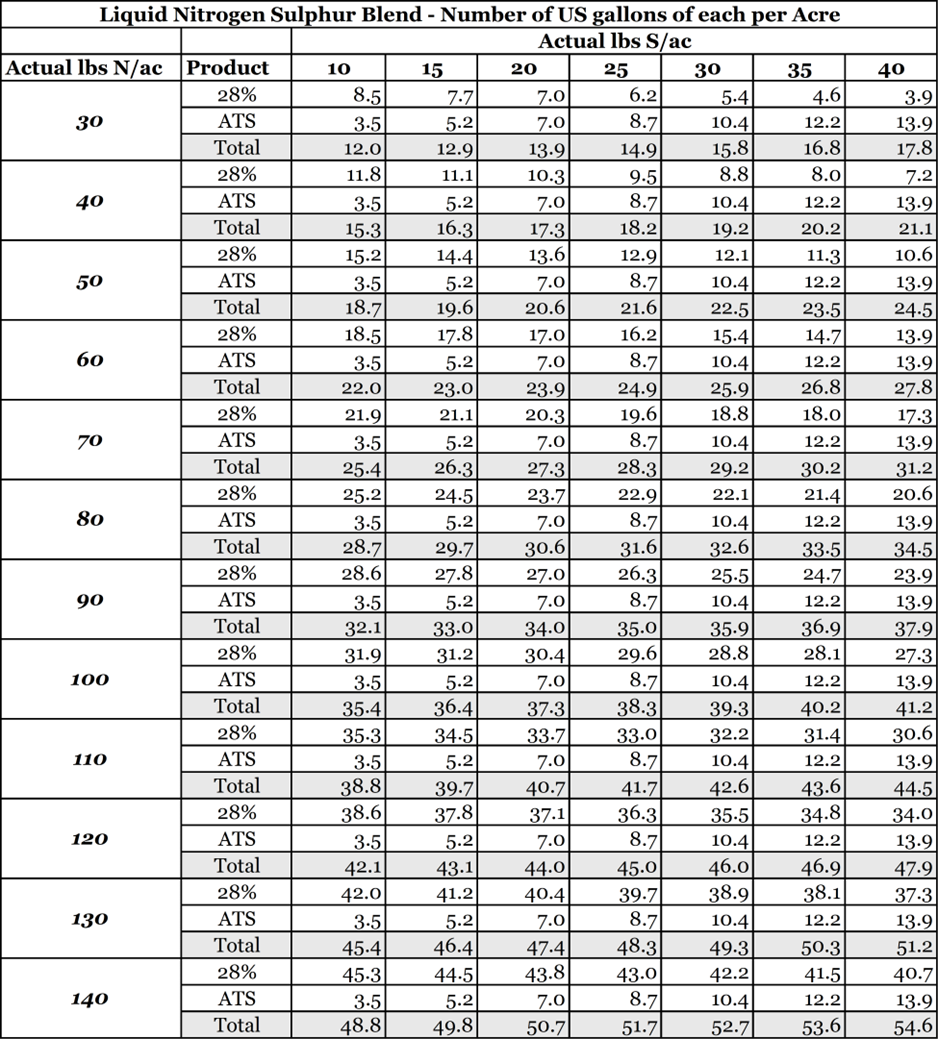
Winter Wheat Fertilizer Rates (JZ)
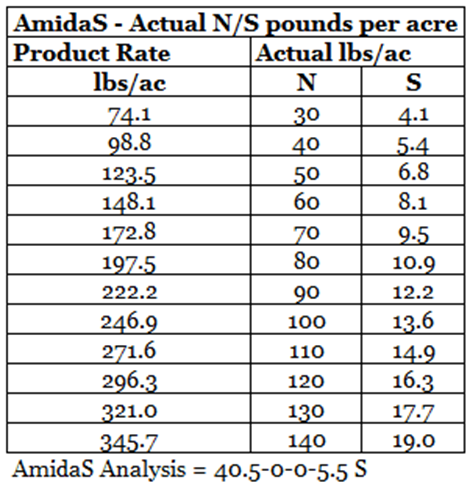
Sometimes you need a quick reference chart on what fertilizer rate to apply. I have made up the following for AmidaS, Urea/AMS and 28%/ATS.
Soybeans
Should I Plant Soybeans First? (From my friend in Indiana Darel Walker. He says it better than I can. I believe the same applies to Ontario maybe add 21 days to his times. Prices are US dollars)
Many growers have adopted the practice of planting soybeans first. If you can’t plant both crops at the same time ,this is a good idea for several reasons. Beans do not suffer in cold wet soil the same way that corn does. With today’s seed treatments, beans will just lie in the ground until it is warm enough for them to germinate. We don’t experience yield loss from uneven soybean emergence, the way corn does. Beans planted in early April usually take 3 weeks to emerge and so are not at risk of freezing damage until early May. Even then, in tilled soybeans it takes a temperature of 28 degrees for several hours to kill them. It does happen but freezing damage to soybeans is rare except in muck soils. Early soybean planting allows soybeans to bloom and set pods during the longer summer days of June and July. Early planted beans also produce more nodes according to BASF research. In experiments conducted in Central Illinois, beans planted on April 16 averaged 20.5 nodes. This was reduced to 17.5 nodes per plant with a May 25 planting date. Losses from planting delay start as early as April 18 in Central Illinois. Research found an average yield loss of .25 BPA/day from April 18 to May 16 worth $2.50/day at $10 soybeans. Whereas corn loses about .40 BPA/day during the same dates which is about $1.80/day at $4.50 corn. Not only do we get more nodes when planting early, we also have potential to set more pods per node because the sunlight quality is better on the longer summer days.
JZ - Unless you have replacement seed available. I would not plant IP or seed soybeans early with risk of frost damage. Outside of that I have been encouraging some producers to plant earlier, if you are doing this you should also increase your maturity to take advantage of the longer growing season planting earlier provides.
Insect Control
New Liquid Rootworm Insecticides for 2026 (Darel Walker CCA IN)
It has been years since we have had a new rootworm insecticide, and now there are two new ones for 2026. Nurizma TM is a new liquid corn insecticide from BASF. It contains broflanilide, a novel group 30 insecticide. The label claims control of rootworm larvae,
Seed corn maggot, white grubs, and wireworm. It can only be applied in furrow between the openers and the press wheels and must be covered with soil. It has a 1oz use rate for 30” rows. It is labelled for all corn types including sweet corn. It has no interactions with herbicides. (editor’s note I checked with BASF and currently it is not apt to be available in Ontario for 2027) OpelloTM is another new group 30 insecticide from Syngenta. (Editor’s note In Ontario it must go through PMRA but maybe we can have it for 2027.) Its active ingredient is isocycloseram, a restricted use pesticide. It is labelled for control of rootworm larvae, wireworms, and white grubs with a 5.25 oz application rate for 30” rows. It can be applied with in-furrow or 2X2 starter systems, or T-Banded over the row. If T-Banded, it must be before press wheels or tines to incorporate it. It can also be sprayed near the row at cultivation. This is good news for growers who do not have insecticide boxes on their planters.
Fertility
Q I just read some information from a retailer that said “nitrogen efficiency seldom exceeds 40% so that for every pound of N, 60% is vulnerable to leaching and volatilization.
Ans (PJL)
While it is true that you only get to use 40% of applied nitrogen and that 60% is vulnerable to leaching and volatilization, the rest of the story is that early spring the soil is too cool to have much volatility. And other than sands, there is very little leaching. I believe a large part of the nitrogen that is not used is tied up in organic matter. The rest of the nitrogen that the plant needs is released from organic matter.
JZ – The microbes will consume nitrogen first to breakdown crop residues where there is a carbon to nitrogen ratio imbalance. We must apply nitrogen fertilizers in a manner that either exceeds the microbe requirements, or avoids being consumed by the microbes, or destroy/move some of the residue in way prevents nitrogen tie up. i.e. baling off the wheat straw before going to corn.
Q Further to that I am told a nitrogen stabilizer can increase my corn yield by 7% and wheat yield by 6%. What do you think?
Ans (PJL)
Show me the research. If indeed there was that big a yield increase everyone would be promoting N stabilizers. The reality is there is no publicly reviewed research from Ontario showing this type of response. To me N stabilizers should be used on very light or very heavy soils. Even then there may not be any payback. The idea of N stabilizers is to reduce the amount of nitrogen needed to achieve your yield. You cannot expect a nitrogen stabilizer to increase yields.
Q – Jonathan, when would I use base saturation on a fertilizer recommendation? (JZ)
A – Many university researchers have tried to use base saturation as a means to do fertilizer recommendations, and the data has more or less been less than conclusive on using those values to make a recommendation. Base saturation is a calculation of the % of the cations being held by the CEC. Think of it as the % of the H, Al, NH4+, Ca, K and Mg of these being held within the soil. These values are calculated off of the ppm of each of these nutrients in the soil. Where Base Saturation can help is understanding if you have an imbalance between Magnesium and Potassium, or I have found it can indicate how sticky/wet a soil is likely to be or perhaps if you should consider using a dolomitic instead of a calcitic lime. I would not use it to determine the absolute value of the fertilizer to apply, partly because the underlying CEC it is calculated off of is already a flawed number to begin with. Most of the research that was completed on base saturation that showed correlation was on very sandy soils with minimal ability to hold on to nutrients.
Foo dust or fertilizer product? (JZ)
The number of carbon-based fertilizer products on the market has exploded in the last 5 years. Here is a summary of the two main actives and where they are used.
Humic acid is used in field crop production as a soil and nutrient efficiency tool rather than a direct fertilizer. When applied with dry, liquid, or starter fertilizers, humic products can improve nutrient availability by chelating micronutrients and reducing nutrient tie-up in the soil. They may enhance root growth and seedling vigor, particularly under stress conditions, and are most effective on low organic matter or highly calcareous soils.
Foliar use:
Foliar-applied humic acids can improve leaf surface nutrient uptake when tank-mixed with UAN, micronutrients, or fungicides. Rates are low, and responses are typically modest and situational (stress conditions, micronutrient deficiencies).
Soil/fertilizer placement (preferred):
Humic acids are generally more effective when applied with dry fertilizer, liquid fertilizer, in-furrow, or 2×2, where they help with nutrient availability, root development, and nutrient retention in the soil.
In short: foliar use is supplemental; soil-applied use provides the most consistent value in row crops. (I asked Taylor Jeffery with Yara about using the Amplix Procote Optimize on urea in-season and he said they tend to have better success with the material when it is applied pre-plant on Urea based internal experience in the US).
Fulvic acid is commonly used in field crops as a nutrient transport and uptake enhancer, and it is more suited to foliar use than humic acid due to its smaller molecular size. When applied foliar with micronutrients, UAN, or fungicides, fulvic acid can improve nutrient movement into the plant and increase availability inside plant tissues. It can also be soil-applied with fertilizers, but its most consistent response is seen as a low-rate foliar additive to improve nutrient efficiency under stress conditions.
Carbon based examples from reputable companies.
What are some examples of these products? Many companies have started added either Humic or Fulvic acids or similar derivatives to increase plant response to macro or micronutrients or reduce abiotic stress. I would personally focus on working with companies that have a strong R&D program or can suggest proper rates based on local experience. For the 2026 season the plan is run a few field trials with these types of products and others to see what performance is like in local conditions.
Precision Ag
Monitor Help Guide
Iowa State has developed an excellent on-line tool that provides screen by screen instructions for operating most of the monitors that are being used. Here is the link to their site
https://r2r.ae.iastate.edu/monitor-simulator/
Business Matters
Q – Jonathan, I understand you are selling weather stations/building a weather network. What value is a weather station to either a farmer or an agronomist working with farmers? - Patrick (JZ)
A - How to use data from a weather station to make decisions
Here is a use case in winter wheat as an example on how to help with the decision making by data. Some of these maybe feature specific to the brand I am working with.
Winter Wheat
Fall germination – calculate soil GDD in the fall to see expected emergence date
Spring green – see if enough soil GDD has been accumulated for wheat to emerge from vernalization
Spring nitrogen applications – check to see if the soil is saturated, use the forecast to time nitrogen applications ahead of rain events, check ground conditions (moisture/temperature) for risk of nitrogen losses.
General spraying – check spraying conditions (wind, rain) to find optimal time in compressed windows
Herbicide applications – check crop staging, temperatures for risk of herbicide damage
Fungicide applications – look at crop stage/disease modelling for risk and timing, leaf wetness sensor for risk of disease (calculates how many minutes the canopy is wet)
Harvestability – check suitability of when to start combining for the day
While I think most farmers and agronomists have a pretty good idea on when to do these things, what I have seen personally is it puts a number to it and brings focus on the metrics that matter.
Your time is limited, so don't waste it living someone else's life.
-Steve Jobs