
The Cropwalker - Volume 9 Issue 29 - Winter Cereal Special

By Jonathan Zettler CPA, CMA, CCA-ON and Patrick Lynch CCA-ON
ALWAYS READ AND FOLLOW LABEL DIRECTIONS
CONFIDENTIAL NOT FOR PUBLICATION
Send us your questions
If you have a question, just reply to this email, we try to have an answer for you within 48 hrs. Or text Jonathan at 519 323 7505 or Patrick at 519 275 1058. If you want a topic researched let us know.
Unable to see pictures? Move this email to your inbox or ask your email app to download them. Usually at the top of the email in a header.
Weather/Crop Conditions
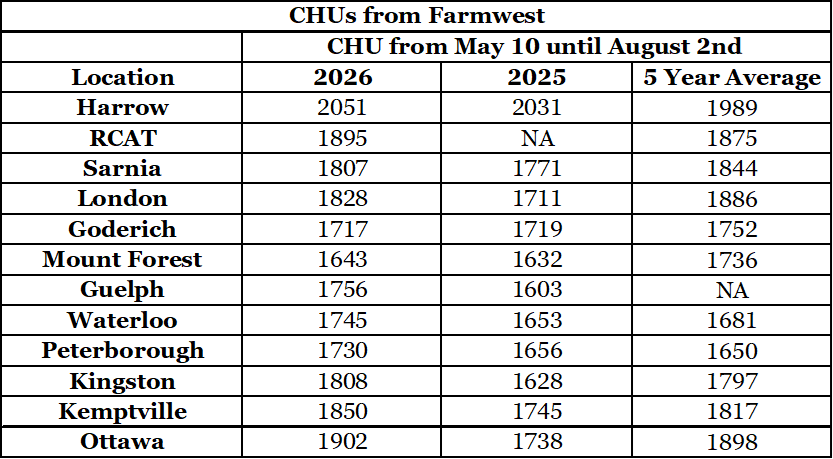
Heat Units are about normal. Across the province some areas had a lot of rain 4” plus (10 cm) over the last few days while other areas are dry and some areas very dry.
Things to do This Week
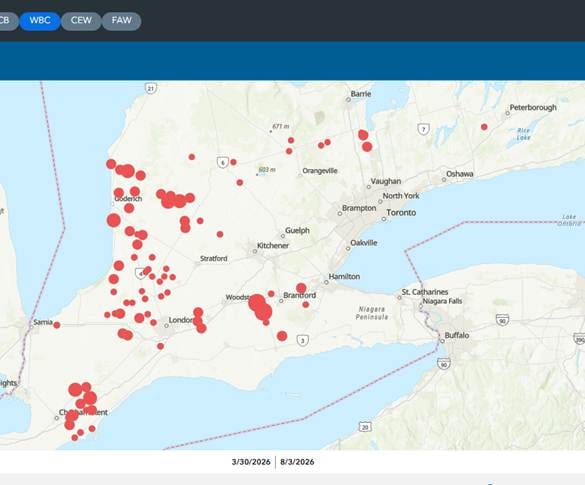
1. Web site for Western Bean Cutworm https://experience.arcgis.com/experience/7164d23d488246d198dcf7a07d8c9021 They are probably moving to edible beans. Keep watching all edible bean fields. This map shows a significant number in the traditional edible bean area.
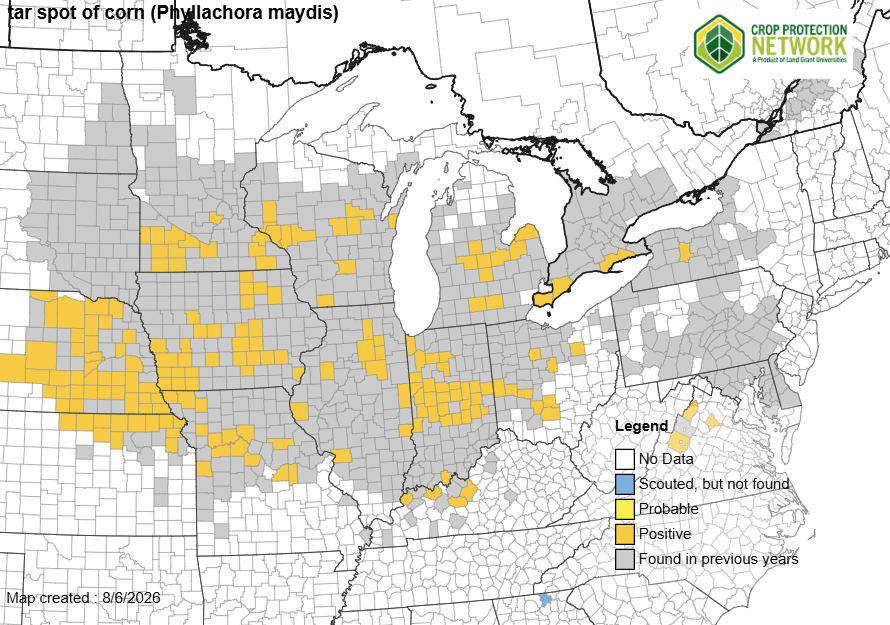
2. Website for tar spot show that tar spot spread again last week. If you sprayed to reduce Gibb and other ear diseases you are probably ok. If you have not sprayed and are west of Toronto seriously look at spraying to protect. If you are east of Toronto, consider spraying your best acres. The disease can be present for about 3 weeks before it is visible. The fungicides are protectants. They do not eradicate disease that has started.
a. https://cropprotectionnetwork.org/maps/tar-spot-of-corn
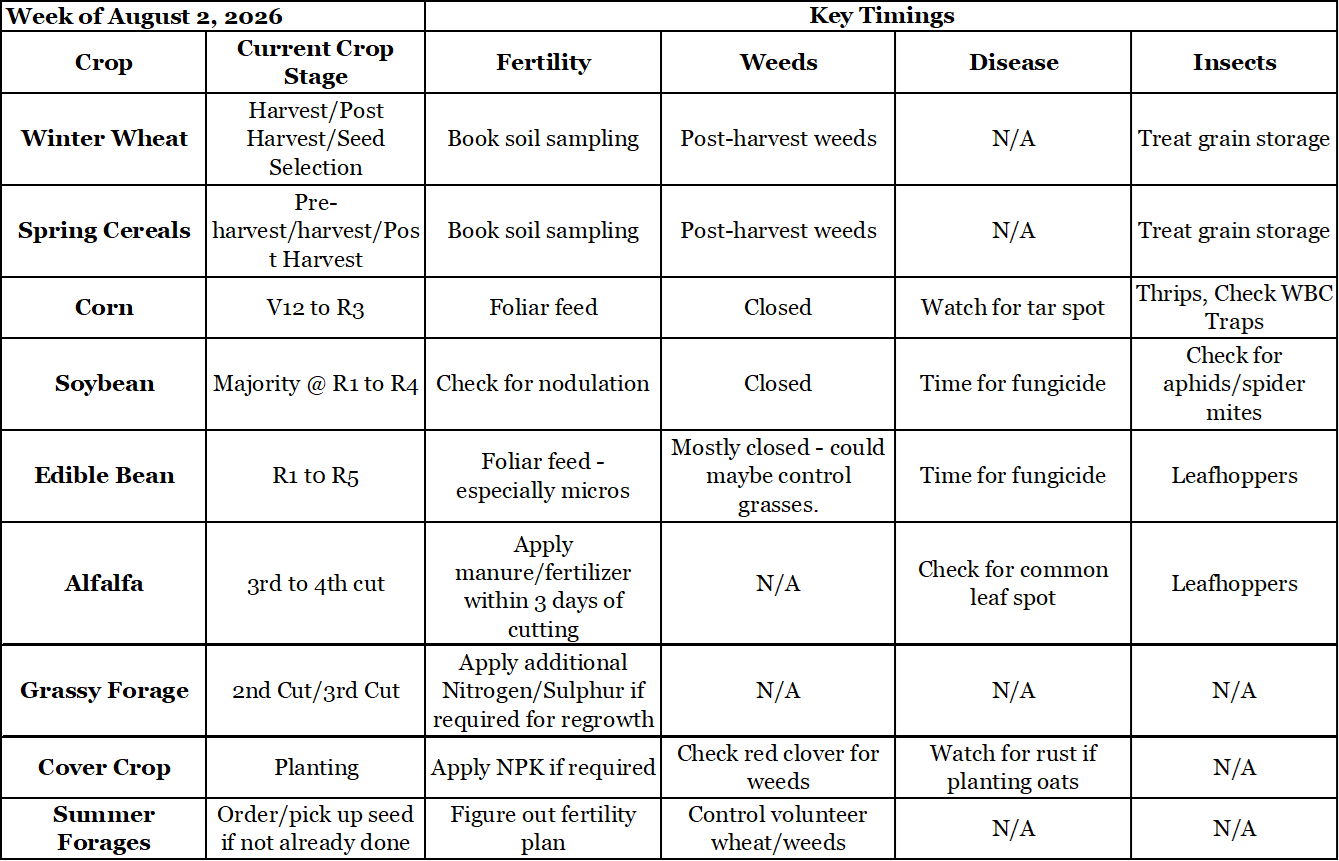
- Plan for the next two years of crop rotations. Decide where you will plant fall wheat, 2026, this will help decide on a soybean variety to be planted in spring 2027 on that field.
- Go over the combine and get it ready for bean harvest. If no tilling winter wheat be sure combine will chop and spread chaff/soybean straw evenly. Once that is done, check the drill and get it ready for putting in winter wheat. If the opening blades were barely cutting corn stalks in the spring when drilling beans, they will not be cutting soybean residue.
- Review this year’s herbicide program to make changes for next year. Record weed escapes and problem weeds by field/farm. Consider using scouting software that keeps track of your herbicide group used each year on the farm.
- Make note of which soybean and edible bean fields will require pre-harvest.
- Summer seed alfalfa. You need a clean field so control all weeds including volunteer wheat.
Diseases the risk tool continues to show high risk for tar spot and grey Leaf spot on corn. If you have not sprayed for ear mould protection, consider spraying to control other leaf diseases in fields or areas of field with high yield potential.
Surprisingly the Risk Tool indicates that white mould is a low risk across the province. In any case it is too late to spray May planted soybeans to control mould.
Diagnostics
What is wrong with my corn/beans/forages? (PJL)
This time of year, this question is asked a lot. Here are some thoughts.
1. Rule out what it is not. Start by taking a soil sample of poor vs good plants that are as close as possible. Take 20 cores from a 100-sq ft area. Then take a tissue sample. Too often we get a tissue sample of the poor area and 1 or 2 nutrients are low. But we do not know how they compare to the good area. Or if we get a tissue test that is low in a nutrient, we have to know if there is enough of that nutrient in the soil and it is just not available due to a number of reasons such as compaction, root rots, insects, another nutrient is high tying up another, pH interaction.
2. Go to the field with an idea what the problem is. If you are right and can prove it, great. If you cannot prove it then you have just ruled out one possibility. E.g., you thought it was seeding depth.
3. If you are sending pictures take one of the whole field as well as the affected part.
4. Often there is a pattern such as every 40 or 80 feet, or 60”, or just on the knolls, or headlands.
5. If it looks like a duck, quacks like a duck, walks like a duck it is probably a duck. If it looks like someone or thing ran over the plants. A porcupine crossing a field affecting early leaves, causing dead plants.
6. Look for an area that seems Ok. Possibly a missed seeded, sprayed, or fertilized area. Failing that check around the outside of the field for clues.
Cover Crops
Q Three questions related to wheat stubble
1) When is the correct time to clip clover?
2) I am surface applying liquid manure onto wheat stubble with a nice even clover stand. When is best time to apply manure? Should I go as soon as possible after straw is removed or wait till clover gets bigger to reduce damage in wheel tracks?
3) Is an application of Yuma/contender/assure worthwhile in a consistent stand of clover to remove volunteer wheat in straw rows?
Ans 1) Clover should be clipped as soon as possible after wheat harvest. You want to go as low as possible without hitting stones. Ideally 3-4", an old haybine would work.
2) Manure needs to be applied when there is little red clover top growth. So, clipping red clover and then applying manure will work. Similar to applying manure to hay fields after cutting you want to apply manure before the new growth starts If you have significant new top growth (50% ground cover or more, the manure can burn the red clover and set it back. Under these circumstances it is better to wait until late September before applying the manure.
3) I don’t believe you need to apply a graminicide to control volunteer wheat unless you have a dense stand of volunteer winter wheat. If there is a dense stand under each windrow, consider controlling the volunteer wheat in these strips.
Q Why has planting red clover after winter wheat not been promoted?
Ans Until the last few years everyone knew it wouldn’t be worth while. Luckily, a number of farmers tried it and are quite happy with the results. If you have good moisture after winter wheat you should get a decent stand. If you are wondering about a nitrogen credit, send me a picture of your field and I will give you an estimate of the Nitrogen credit. (PJL)
Forages
Q I sprayed wheat with Infinity FX. Can I plant alfalfa there in August? (PJL)
Ans, I asked Jess Wettlaufer from Bayer this question.
She said. “Our label says you must wait 10 months. We have seen significant injury to summer seeded alfalfa when Infinity FX was sprayed in the spring before seeding. (While some times) we have seen growers get away without damage when there was significant moisture after spraying, this is an off label practice.” Generally good moisture after planting will reduce herbicide carry over.
Weed Control
Here is a link to my latest article in Better Farming Tillage for Weed Control
https://www.betterfarming.com/flippingbook/betterfarming/2026/august/52/index.html
Business Matters
Great Ontario Crop Tour Yield (PJL)
Is occurring again this year. Here is a link to register for the meeting
https://riskmanagement.farms.com/events/ontario-yield-tour-2026/tour-events
I will be speaking on August 20th at Moose Creek on the final day of this tour
Speaking of Corn Production, Then Now and the Future
Agenda viewable at the link.
They are also looking for farms across Ontario to do a yield estimate. If interested use the link to register your farm
Fall 2026 Winter Cereal Special
Fall 2026 Winter Cereal Selection
Thank you to those that have put time and effort into Ontario cereals, it has paid big dividends for the 2026 crop. A summary of top genetics and a few suggestions on management practices in one place.
Winter Barley vs Winter Wheat (JZ)
Reasons to grow winter barley over winter wheat.
1) You like the quality and volume of straw from the winter barley
2) You want to double crop soybeans or another feed crop after the barley is off
3) You want to spread out your workload
4) You have a strong food grade or feed market for the barley
5) You farm water limited soils and want an early flowering cereal crop in the rotation
6) You have been growing spring barley for feed and would like to increase your yields by 1.5 to 2x.
Largest Self-Induced Yield Limiting Factors in Winter Wheat (JZ)
In no particular order.
1. Seeding Date. Check the gocrops.ca website at bottom of page for Optimum Planting date in your area.
2. Lack of starter phosphorus fertilizer. Soil testing is an imperfect science and cannot account for all weather conditions or soil fertility scenarios. Starter phosphorus puts a floor under your yield potential. It is 4x more efficient vs broadcast on a per pound of P basis when it comes to yield response. Use a minimum of 30 lbs./ac P2O5.
3. Uneven spreading of previous crop (soybean) residue when trying to no-till wheat.
4. Improper drill maintenance, leading to an open seed trench and hair pinning and, in some situations, uneven depth control (i.e. loose JD seed boots).
5. Shallow planting leads to heaving, open seed trench. (I like to see 1.5" inches, when this occurs on the soils I work with, I see less winterkill/heaving in the spring).
6. Lack of awareness on thousand kernel weight (TKW) to set the drill to seeds per acre, rather than pounds per acre.
7. Use of improper seed rate for the time of year/yield potential. The plant will put out less tillers if you have adequate seed. Tiller heads contribute less to yield than main heads in winter wheat, out of everything you do to maximize yield potential in wheat, getting the right seeding rate is mission critical (adjust based on planting date!).
8. Fall weed control – hybrid rye, winter barley/wheat should start with a clean, weed free seed bed in the fall.
9. Tillage before planting can increase yields. But if you bury white mould sclerotia expect worse white mould in the future.
- Barley Yellow Dwarf Virus - this virus is quickly becoming the number one issue in winter barley, and also rapidly becoming an issue in winter wheat. While research is likely coming in the future on how to address this issue, later planting dates in the fall and use of insecticide seed treatment can help with fall infection. There are possibly differences between genetics, no data currently available on differences for genetic resistance. See this article from the UK on their experience. https://ahdb.org.uk/news/what-is-the-value-of-bydv-resistance-tolerance-in-cereals
Winter Barley
SeCan
Integral - is a new 6-row winter barley with a significant bump in yield over current available varieties. Excellent standability and very good disease add to its strong agronomic package.
LCS Calypso - is a 2-row winter barley with strong yields, malting quality, and excellent winter survival. Based on earlier harvest maturity than winter wheat, winter barley varieties including LCS Calypso allow for more crop rotation choice and are a flexible double crop option for grain or forage. Certified seed is available from SeCan retailers across Ontario.
SU Ruzena - is a 2-row winter feed barley available from SeCan. Similar to LCS Calypso, another SeCan winter barley variety, SU Ruzena has improved winter hardiness and grain yield compared to previously marketed winter barley varieties in the province. It has a slightly shorter plant height and better standability compared to LCS Calypso and is well suited to intensive management.
Winter Wheat
A summary of current market offerings for fall 2026, in alphabetical order. Please note not every variety on the market is listed.
C&M Seeds - Tim Meulensteen
Soft Red Winter
Blaze (awned) – Excellent yields with great winter survival. FHB-1 gene (prevents secondary infection) for excellent fusarium tolerance. Strong stripe rust. Small seeded for seed cost savings. Medium-tall plant height with decent standability and lots of straw. If you are an organic grower, look for this one (due to plant health and strong fusarium tolerance). Well suited to all soil types and regions. Responds well to PGR.
Fuze (awned) – NEWEST SRW variety. Third year for sale, and the interest is growing rapidly. Very strong yields across many plots through the region. Medium height and stands quite well. Nice even canopy. Excellent yield and also has the FHB-1 gene to assist in protecting against fusarium spread. Early-mid maturity, with excellent thresh ability reports. Good seed supply, but order early. Looking to try Fuze all over Ontario this fall.
Swoop (awnless) – Third year of consistent results. Seems durable in more challenging soil conditions. Being used across Ontario and into Eastern Canada. Bigger plant, lush canopy, responds well to intensive management. Protect with early fungicide to avoid mildew and stripe rust pressures. Use lighter seeding rate, and a PGR in high fertility soil to resist lodging. Will provide big straw volumes as well.
NEW EXP SRW – 2nd year OCCC registration, only in plots this year, watch for it next fall!
Hard Red Winter
Hard Red Winter Wheat is in BIG demand in Ontario for coming years. ONTARIO MILLS NEED MORE. Ask your grain buyers about premium pricing opportunities. C&M Seeds positions both Adrianus and Pro81 as having yields close to soft red wheats, while maintaining a stronger functional profile when grown with proper intensive management. Split App fertilizer is required to boost protein.
Adrianus (awned) – It is medium-tall, with awns, and excellent plant health. It is a later maturing variety and gives a nice plump clean grain sample. Very high-quality grain sample maintained right through duration of harvest. MAXIMUM straw volumes. Superb natural standability. Only consider low-rate PGR if grown in ultra-aggressive fertility. Suitable for all soil types.
PRO 81 (awned) – It has a strong natural leaf disease package, and tall plant height. Small seed size makes it easier to plant high populations. PRO 81 will tiller aggressively and create an impressive and dense canopy. Rated as suitable for all soil types and regions. Plan to use a PGR. Very large straw volume. Strong protein and functionality. OCCC benchmark for the class.
Redford (awnless) – Second year for commercial sale. Very big canopy with aggressive vigour and growth. HUGE flag leaf. Very “handsome” looking crop. Deep lush canopy colour that catches the eye from start to finish. Elongated seed head. Plump kernels. Protect with early season fungicide. Expecting BIG straw volumes. Mid to late maturity. Keep an eye for this one and give it a try. Limited quantity available.
Pioneer - Greg Stopps
25R29 (Awned) - Full maturity variety heading similar to R40 but later to physiological maturity. High yield potential, with well-balanced agronomics. Strong Fusarium Head Blight performance (FHB genetics), excellent standability, winterhardiness, and test weight. Stripe rust performance is average warranting fungicide control. The tallest of current Pioneer commercial varieties, still showing excellent lodging resistance.
25R64 (Awned) – Full maturity variety with similar physiological maturity to 25R40. Suitable for high management acres. Yield leader continuing to show significant yield advantage over all other commercial varieties over multiyear field testing. Excellent standability and well-balanced agronomic disease protection including good fusarium head blight (FHB genetics), and good winterhardiness. Stripe rust performance appeared average in 2024, and below average with over wintering populations of stripe rust in 2025 and 2026– the apparent change in stripe rust tolerance in eastern Canada is currently being investigated, but fungicide management should be a strong consideration to control rust under high pressure. Plant height is taller than 25R40 but typically shorter than 25R29. Test weight is average but should be a consideration in stressful or high disease pressure environments where grain fill tends to be cut short.
25R65 (Awned) – Mid maturity variety with heading date and physiological maturity similar to 25R40. Multi year yield performance equal to or ahead of 25R64 in SW Ontario. Overall leader on general wheat acre in south central Ontario and northeast. Excellent standability and winterhardiness. Strong disease package including in-field performance on fusarium head blight. Stripe rust is average showing consistent performance in 2024 and 2025, and 2026 but still warranting control under high pressure. Plant height is similar to slightly taller than 25R64.
New P25R402 (Awned) - Limited Plot Quantity Only in Fall 2026 - Commercial volumes available fall 2027. Mid to late maturity variety with heading date and physiological maturity similar to 25R40 and 25R64. Brings yield performance similar to 25R64 and 25R65 with significant improvements in disease performance on common rust, stripe rust, and powdery mildew. P25R402 further brings improved test weight and falling number to the lineup, as well as improved lodging resistance with plant height slightly shorter than R65. Strong winterhardiness scores and good FHB performance round out a very strong new varietal wheat entry for the soft red market.
SeCan - Mathew Hooyer
By supporting SeCan soft red winter wheats, you are buying local! Developed by the University of Guelph in partnership with the Grain Farmers of Ontario and SeCan, we strive to provide strong soft red winter wheat varieties suited for the Ontario marketplace and climate conditions.
Caldwell - is a new soft red winter wheat variety with top performance across areas 1,2,3 in OCCC trials. It is a racehorse that rewards intensive management with exceptional yield response.
OAC Constellation - Well-rounded, awned SRW wheat that provides winter survival, standability, straw, yield, test weight and grade retention. OAC Constellation continues to impress growers with high falling numbers and strong test weights. This variety holds up to stripe rust and leaf rust and early disease pressures including septoria and powdery mildew. This is a very well rounded soft red winter variety that won’t disappoint.
OAC Moon - awned soft red winter wheat with short plant height and great thresh ability. This ‘racehorse’ variety will push yield and reward growers who intensively manage their wheat production. Small seed size translates to lower seed costs per acre.
OAC Virgo – Another soft red winter wheat variety developed by the University of Guelph and marketed by SeCan retailers. OAC Virgo is broadly adapted for every winter wheat acre across the province. Its well-rounded disease package is suited for growers who are using less intensive management or following organic production practices. While not truly awnless, this variety has very short awns called awnlets and is ideal for growers who want a variety with minimal awn volumes.
Snobelen Farms - Ryan Snobelen
Snobelen Farms has a diverse and powerful winter cereal lineup that includes 6 soft red varieties (GRO-08SRW, B654-SRW, Branson, Caldwell, OAC Virgo, OAC Constellation) 1 soft white variety (Ava) and 2 winter barley varieties (LCS Calypso, SU Ruzena). Our lineup will allow you to select the best variety for your farm.
Soft Red Winter
GRO-08SRW - awned- a short-medium tall plant with great standability. Very good winter survival. Good well rounded disease package. Known for consistently heavy test weight. A top performer that rewards management with bushels.
Branson - awnless - a veteran variety that consistently performs at a high-level season after season. Excellent plant health and disease package can make this variety a valuable risk management tool on farm. Medium plant height with excellent lodging scores. Suitable to all soil types. Good test weight.
B654-SRW - awnless - tallest variety with excellent straw volume. Large size grain heads deliver excellent performance. Well rounded disease package. Above average test weight. Responds well to intensive management.
Soft White Winter
Ava - awnless- tall variety with excellent standability. Very good straw volume. Consistent strong yields for soft white variety. Moderately Susceptible fusarium rating. A veteran proven variety that delivers.
Hybrid Rye
KWS - Étienne Papineau
Hybrid Rye is suitable for sandy or lighter soil textures where having adequate moisture is a concern for winter wheat. End users like the consistency and high-quality grain while providing strong tillering and plant health for those growing it.
C&M Seeds
C&M Seeds is moving to KWS Inspirator to lead the charge in Ontario. (Brasetto is finished, the IP Programs will accept Inspirator). KWS Inspirator combines strong biomass production, excellent standability, and robust disease resistance, with reliable yield and quality to match.
KWS Trebiano, a well-known and dependable variety, is also available for sale.
Agromart Group
KWS Attainor is the Agromart network’s newest variety, offering best-in-class winter survival, strong grain yield, and excellent standability.
KWS Serafino, an established variety with an excellent track record, is also available for sale.
All KWS hybrid rye varieties are dual-purpose and can be used for forage and grain production. KWS varieties have PollenPLUSTM, a proprietary ergot reduction technology which is exclusive to KWS hybrids.
This week warrants two quotes from Clint Black
"I never liked the rain until I walked through it with you."
"Life is too short to not go after what you want."
Clint Black