
The Cropwalker - Volume 9 Issue 39

By Jonathan Zettler CPA, CMA, CCA-ON and Patrick Lynch CCA-ON
ALWAYS READ AND FOLLOW LABEL DIRECTIONS
CONFIDENTIAL NOT FOR PUBLICATION
Send us your questions
If you have a question, just reply to this email, we try to have an answer for you within 48 hrs. Or text Jonathan at 519 323 7505 or Patrick at 519 275 1058. If you want a topic researched let us know.
Unable to see pictures? Move this email to your inbox or ask your email app to download them. Usually at the top of the email in a header.
Weather
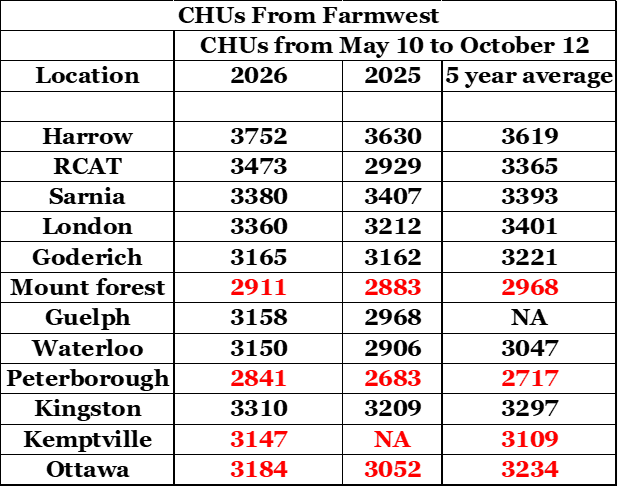
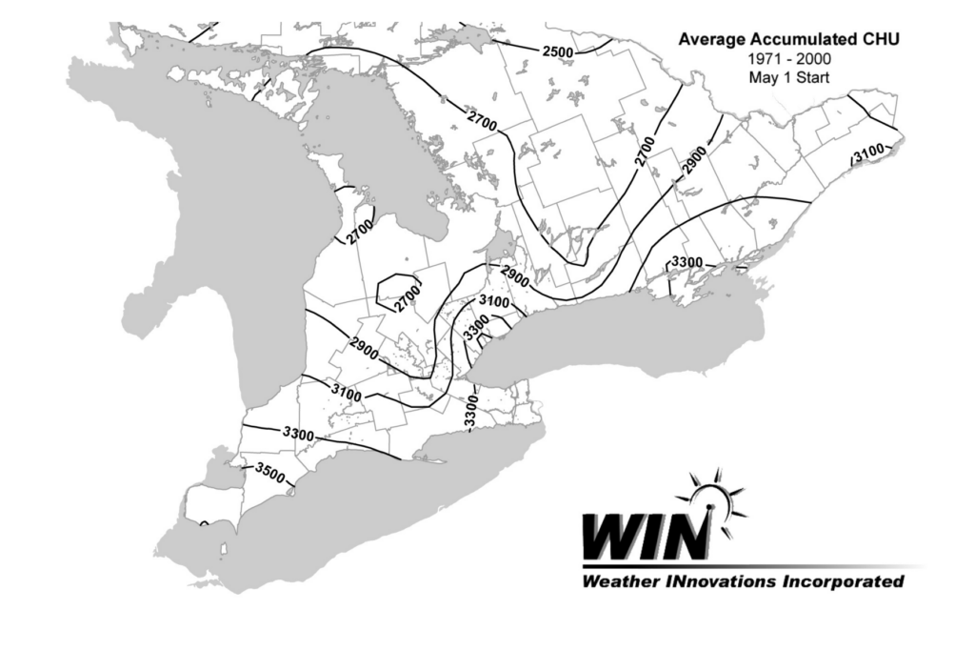
Table below shows that we are about normal. Areas that I believe have had a killing frost I have put in red to indicate CHUs to the end of the growing season. Below the table is the CHU map for Ontario. Interesting looking at the map and the 5-year average. In many areas the 5-year average is significantly higher than the map shows. Most farmers will look at RM and how hybrids matured in their area as opposed to looking at a hybrid’s CHU ratings.
Corn Heat Unit Map | Ontario Corn Committee
Crop Conditions
Soybean harvest varies across the province from 50-65% done in much of western Ontario. A good 50% is off in Niagara area and central Ontario. Eastern Ontario has maybe 35% off. Yields have been great. Not as much mould as anticipated. Good soil moisture packed on bushels. Probably looking at record yields. Winter wheat planting is 75-90% complete. Good soil moisture so this crop is off to a good start.
Things to Do This Week
1. Check corn fields for standability. Fields not sprayed with a fungicide will be more prone to lodging when the winds come, as well as fields that ran out of nitrogen during the later part of grain fill.
2. Check winter wheat for winter annuals, especially fleabane, and fields coming out of canola. If you want to seed red clover next spring, control these weeds this fall.
3. Check soybean ground for perennial weeds and fleabane, if it didn’t get a pre-harvest application and won’t be getting fall tillage consider spraying now.
4. Consider seeding some cereal rye on soybean ground that will not be planted to wheat. At 50-75 lbs./ac, this would be a $10-20/ac investment, depending on supplier and rate.
5. JZ – I would like to try and have my soil sampling wrapped up by December 1st, if you have fields that aren’t on the books to get sampled, book them ASAP.
6. Make sure everyone knows where the fire extinguishers are and how to use them. One reader told us they had a fire and it took some time to find the extinguishers.
Weed Control
Q - What is better for dandelion control, 2,4-D or dicamba? (JZ)
A - 2,4-D has better activity on dandelions than dicamba, however if you are using dicamba for other reasons, the glyphosate will typically take them out. If they are quite large, ensure you are using at least the high rate (1.3 L/ac)
Fall Fleabane Control
If you had fleabane in soybeans this year, consider controlling them this fall. (Many springs it starts to rain, and you can’t get to them until they are really big.) If you have a field destined for soybeans next year, you must control them now. Tillage will control the small rosettes, but not the large ones. Tillage will just move them around (well maybe not if you used the plough). One strategy is to spray with Eragon plus Merge and Roundup plus 2,4-D or dicamba (if they are big) and then plant fall rye to help smother the ones that germinate later. If you do not plant fall rye, then at least spray fleabane off. The key is to never allow fleabane to get to a point it is too difficult to control.
Q - I used the 60 mL/ac rate of Eragon LQ this fall. Will I have to spray my winter wheat next spring?
A - It depends. The 60 mL/ac rate does provide some residual control of winter annuals, which would mean you can delay your spring herbicide application. You may still have to do a delayed spring herbicide application if a) you have a high pressure of annual weeds, and a thin canopy b) you have perennial weeds (which might be better off with a pre-harvest depending on weed pressure/herbicide timing/wheat stage), and/or c) you have a spring/late fall population of Canada fleabane. Sometimes using MCPA Amine @ 0.4 L/ac is enough in the spring to hold back the annual weeds.
Which registered fall wheat herbicide should I use for what weed spectrum? (PJL/JZ)
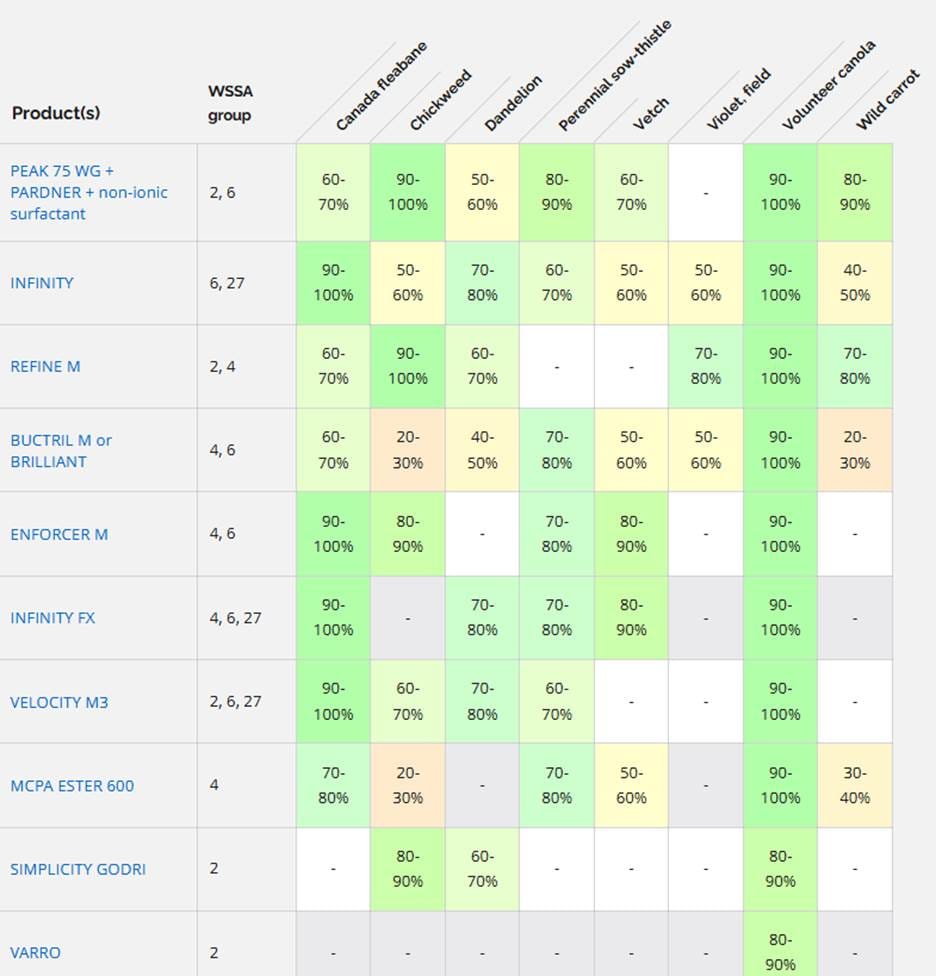
We worked out a common list of fall weeds and produced the following: Canada fleabane, chickweed, dandelions, Perennial Sowthistle, Vetch, Field Violet, Volunteer canola and Wild carrot. We ran through the fall application timing to see what registered products are the most effective at controlling the various weed species. Chart is listed below.
The speedwell family (which is a major weed in Jonathan’s area) seems to be missing from the ratings, but any product with MCPA in it seems to be effective in controlling it.
Fall Burndown Weed Control
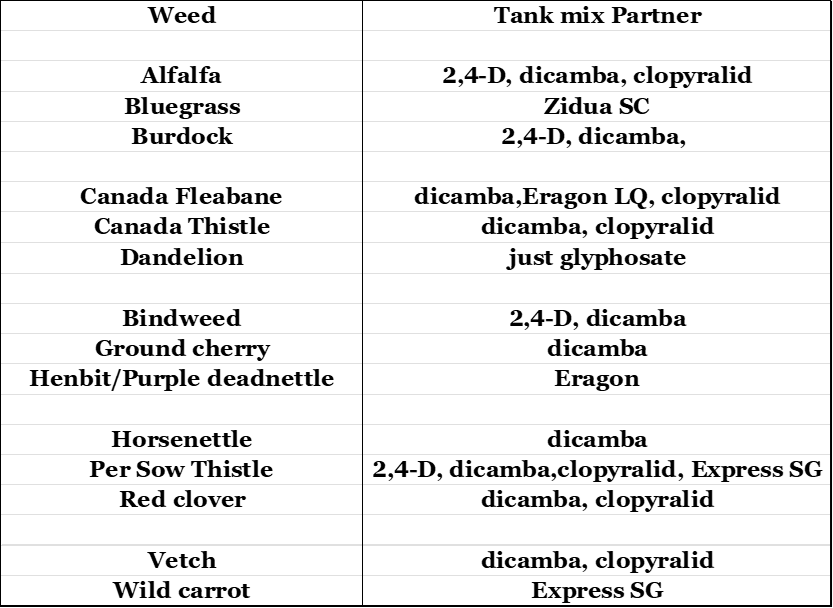
Mike Cowbrough OMAFA has provided the following information. The intent is these products are tank mix partners with glyphosate for fall burndown weed control. Some of these products cannot be used on fields going to winter cereals.
Soybeans
Q - My soybean yields were disappointing, what are some possible causes or things I should change for 2027? (JZ)
A –
1. Poor populations, a few fields had reduced plant stands due to a number of issues at emergence.
2. Low fertility – dry weather conditions plus low fertility equals significantly reduced nutrient availability.
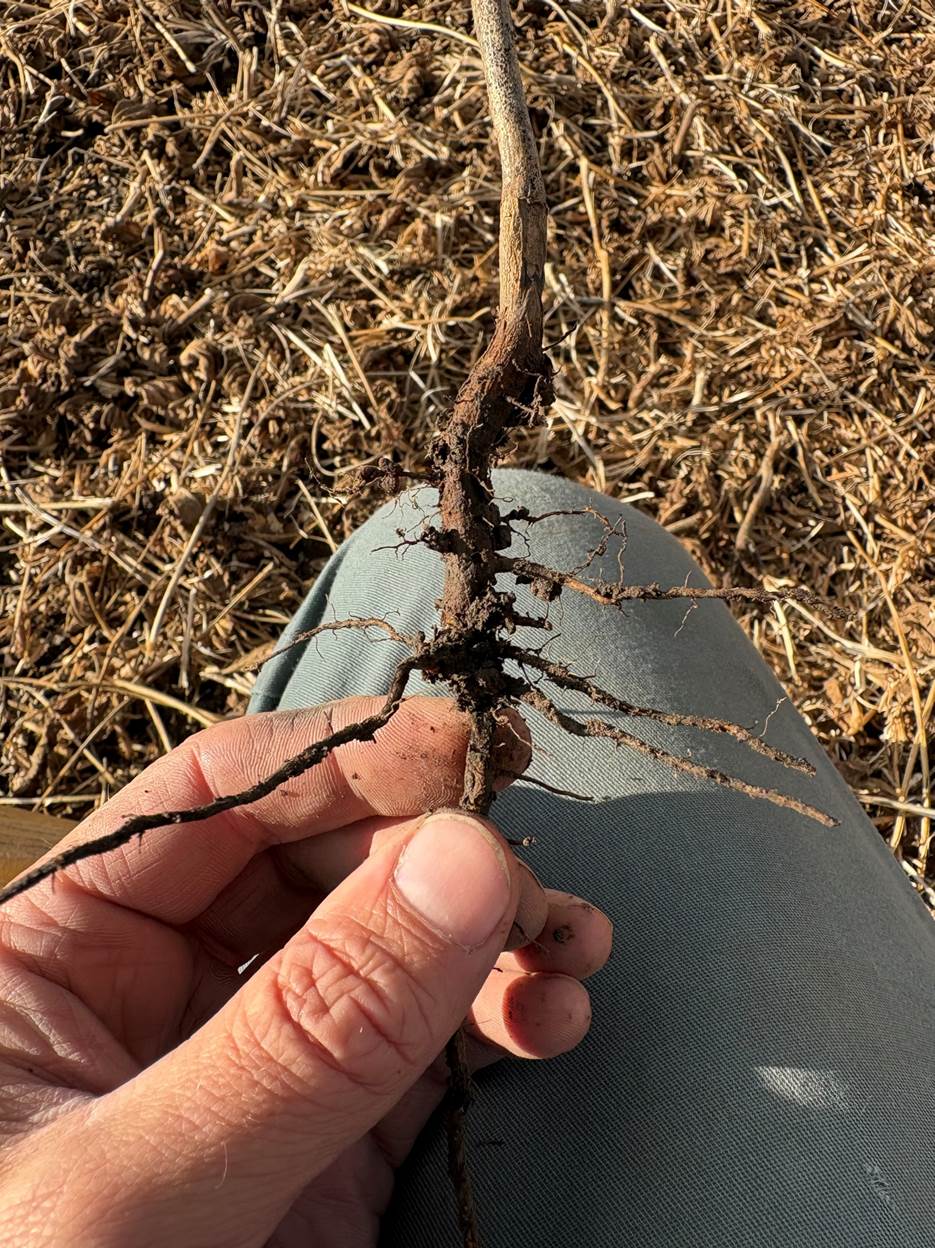
3. SCN/Root rots – Dig up your plant roots, what are you finding on the roots? These are critical to getting nutrients into the plants.
4. Background nitrogen – Seems this year that there was reduced nitrogen mineralization from the soil and wonder if that took the top off some soybean fields?
5. Weed control – were plants set back due to poor weed control?
6. Herbicide carry over/injury? Maybe not as common, but this does periodically show up if recropping restrictions are forgotten about. A few fields also had reduced plant stands due to crop injury at the emergence stage.
White Hilum Variety Selection (JZ)
Growing this class of soybeans isn’t for everyone. You need to be “pickier,” and the harvest window is much smaller as you are unable to have staining. Weeds like water hemp and palmer amaranth are harder to control in these beans.
There is a fairly small variety list on the market. You essentially have the Silverline lineup (old NK genetics) S03-W4, S04-K9 and S07-M8, Secan’s OAC Strive, Maizex and a couple of one-off varieties that are owned by individual processors. First, you need to decide which processor you want to work with. Not all varieties are available at every seed dealer or accepted by all processors. 2nd, you need to decide which row width you are planting and if SCN is an issue. The 4th consideration is likely white mould susceptibility, 5th maybe phytophthora root rot tolerance.
Should I Grow IP or NON-GMO Soybeans Next Year? (JZ)
You should own your own combine. If you do not, have one heck of a custom operator.
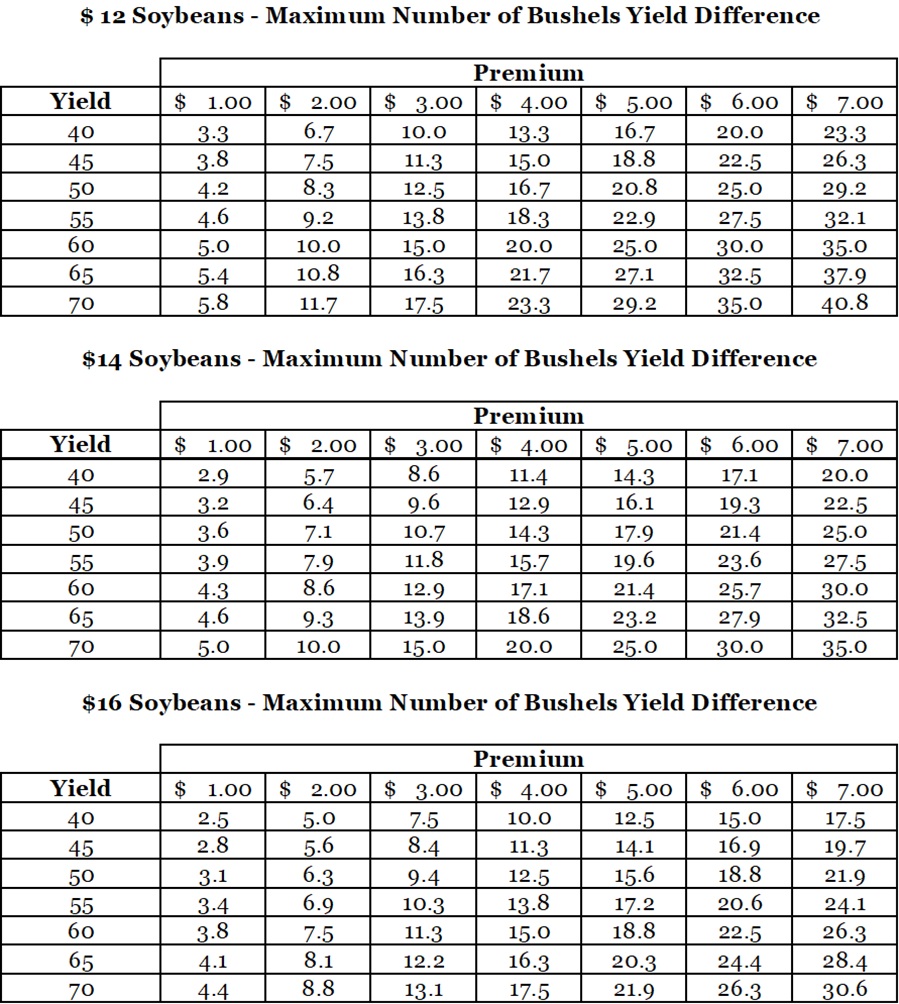
How much difference can you have and maintain the same gross dollars. Below are three charts at different price points. The value within the table is the maximum number of bushels you can give up at different yield levels and premiums to breakeven at a crush soybean price. The spread of resistant weeds and increased incidence of SCN is making it easier to grow GMO soybeans.
Locally it seemed the spread between RR and IP soybean yields was narrower than other years. Add a $4-5/bu premium for some market classes of soybeans and at $16/bu soybeans at 50 bu/ac, you needed another 12-15 bu/ac of yield for the RR genetics to come even on the gross revenue.
Premiums are likely to be flat or have a cap on acres, especially on non-GMO soybeans, the premium on white hilum beans seems like it could erode based on speaking with a few exporters.
If you have lower soybean prices, you can now buy a wider yield spread in an attempt to maintain revenues if premiums remain similar. What does that mean to your bottom line? When reading the chart below, if you have $14 soybeans and your IP soybeans are yielding 60 bushels, and you have a $4/bu premium, you need the RR soybeans to yield 17.1 MORE bushels (77.1 bu/ac) than the IP soybeans to have the same amount of revenue. Is it possible? On individual fields, certainly, across the whole farm operation, maybe not, but not every acre is always also able to get the premium depending on the field, growing season and weed history.
Comment from Eastern Ontario on Our Priority in Picking Soybean Varieties
Morning lads –
I like your list of factors to consider when choosing soybean variety. At Sullivan Agro we coach growers differently on picking soybean varieties.
Part of it is growing area. We have far less non-GMO soybean than what JZ tells me in his customer base. A little surge this year with customers but so far, no extra ROI. Soil applied herbicide provided great weed control so not a lot extra spent on weed management. We will have many growers with average farm yields in the high 60s to low 70s this year. I share below how this happened from a variety selection perspective. I have reordered your list to the order for my area.
6. Yield, but this is not as important as the other factors since all the other factors affect your yield. (We had this listed as #6. Paul had it listed as #1)
Paul's comments I consider high yield or consistency of yield to be something I can not create. Yield only declines once the seed goes into the soil. I want to pick as high a yielding variety as I can. I would suggest everything else falls in line around yield rather than the way you put it. Last fall picking 3 of the highest performing varieties from one company, I came up with an extra $100 / acre difference vs another company. Yield (about 3 bu/acre) and management requirements (around weed control strategy).
PJ comments I agree with Paul’s comments. The points we made will be in a different order in different locations. We put these factors out to encourage discussion. I placed varieties with herbicide tolerance high, because of a significant number of fields this year that showed up with waterhemp or fleabane and there were no post options. One grower had to burn off the whole field and plant Xtend beans because the weed escapes could not be controlled.
Corn
Crown rot is starting to show in Ontario. This disease is more common in the US. The link below tells you more about this disease.
https://cropprotectionnetwork.org/publications/frequently-asked-questions-about-crown-rot-in-corn
"The early bird gets the worm, but the second mouse gets the cheese."
Steven Wright