
The Cropwalker - Volume 9 Issue 6

By Jonathan Zettler CPA, CMA, CCA-ON and Patrick Lynch CCA-ON
ALWAYS READ AND FOLLOW LABEL DIRECTIONS
CONFIDENTIAL NOT FOR PUBLICATION
Send us your questions
If you have a question, just reply to this email, we try to have an answer for you within 48 hrs. Or text Jonathan at 519 323 7505 or Patrick at 519 275 1058. If you want a topic researched let us know.
Unable to see pictures? Move this email to your inbox or ask your email app to download them. Usually at the top of the email in a header.
Things to do This Week
1. Check forage supplies in storage and make sure you are seeding down enough acres.
2. In parts of the province without snow, plan for nitrogen + sulphur on winter wheat.
3. If you have not started already, get ready to spread red clover seed.
4. I have suggested this before but it’s not happening. So here goes again, make sure there are locks on all your seed and pesticides supplies. A lot of people with nothing to do driving around looking for free farm supplies to pick up and resell.
5. Get your specialty fertilizer products booked, if you haven’t made a fertilizer plan already.
6. Make a plan where you will store/hide keys to all equipment. Do not need to arrive some busy morning to find out someone went joy riding on a piece of your equipment.
7. Make a list of corn hybrids and hybrid populations. Do you have enough seed on hand for optimal populations?
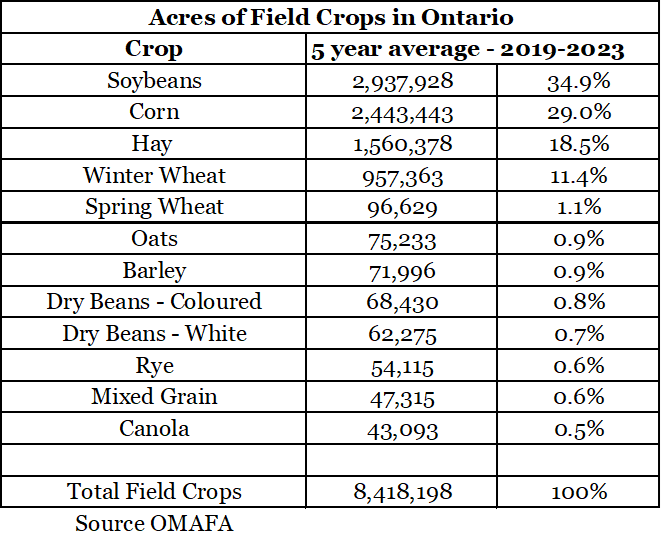
Acres by Field Crop in Ontario (JZ)
I had put this together for another presentation, here is a copy for general interest.
Cereals
Delaro Complete vs Stratego Pro on Winter Wheat (JZ)
At a recent Bayer training event, research agronomists Kurtis Pilkington and Annemarie Van Wely shared what they have found regarding a T1 fungicide application. Historically with in Bayer's portfolio, Stratego Pro has been the standard for controlling early season leaf diseases. However, in the last two years I have seen increased amounts of Powdery Mildew in the fields, especially high management fields. At high disease sites, Delaro Complete has shown to have an advantage over Stratego Pro, as the addition of fluopyram enhances the control of moulds and mildews and has a greening effect to boost plant health. Cost wise, expect to triple or quadruple your money over using Stratego Pro if you have powdery mildew pressure.
#47 Recording Breaking Wheat Joanna Follings OMAFA (PJL)
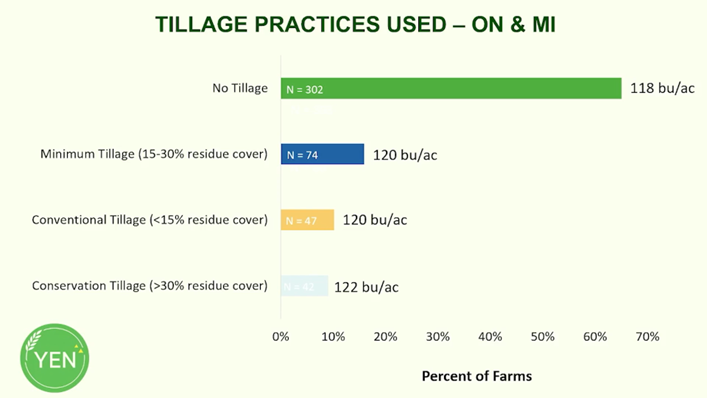
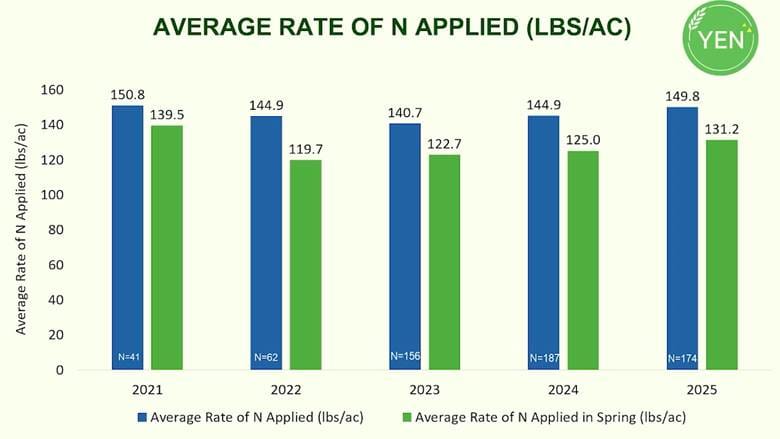
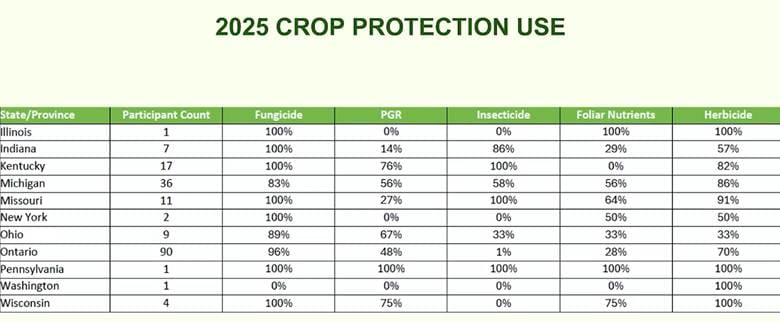
Great presentation. Below are slides from that presentation . I will show you more next week
1) The first slide is tillage practices in Ontario and Michigan
2)Next is nitrogen rate Most common is around 140 actual N
Crop Protection use. I am a bit surprised at number of growers who used a plant growth regulator (PGR)
Weed Control
Interesting Data from Bayer (PJL)
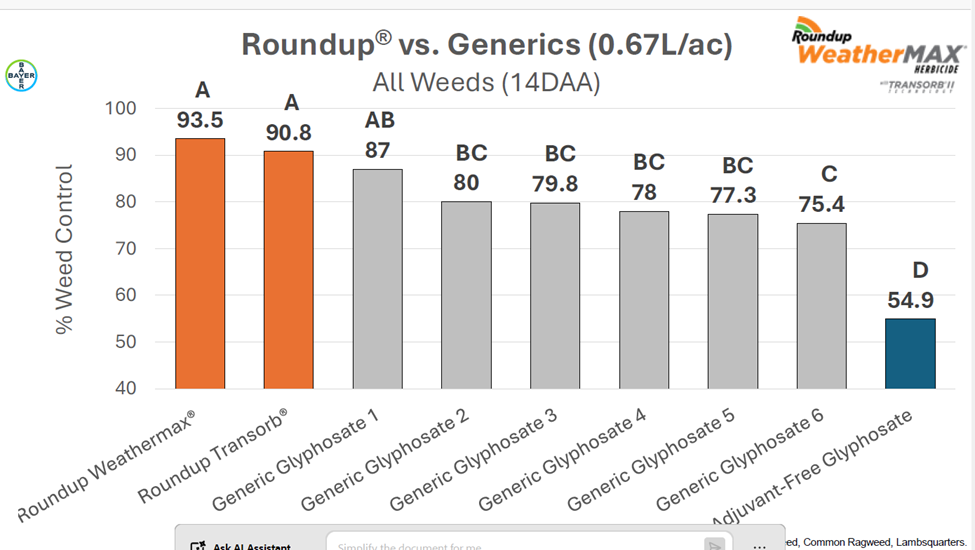
At a meeting last week Bayer shared their research on their brand of glyphosate. Roundup WeatherMax and Roundup Transorb. They compared their two products to a number of generic glyphosates. Their research looked at home much kill you would get on a broad spectrum of annual weeds in their research plots. The graph below tells the story
Q – Jonathan, what are your thoughts on developing an open-source green on brown “See and Spray” type technology? (JZ)
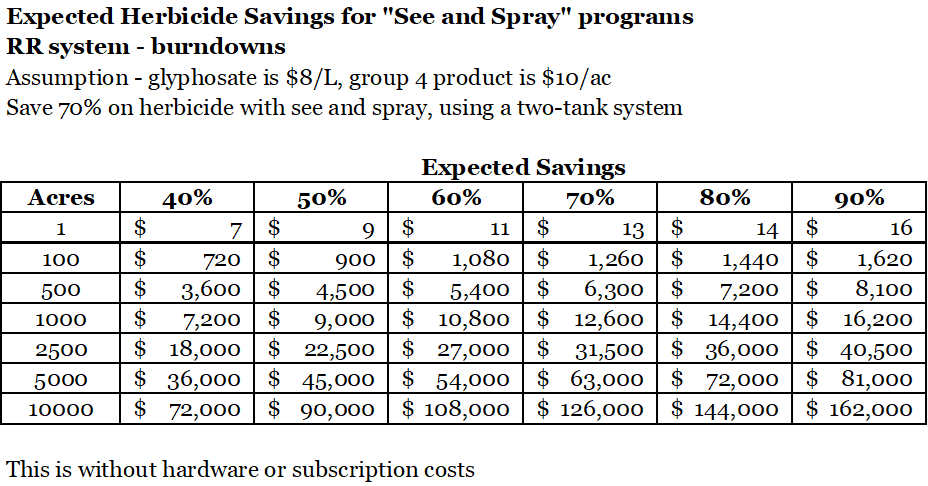
A – If the customer has a two-tank system, I think it could show great promise, as many of my clients are applying both a residual and a knockdown type of program at the same time. If it is a single tank system, the use case is still there but possibly a bit more limiting when it comes to expected benefit. Here is the potential savings. Feedback so far from those running this type of technology has been about 70% savings on herbicide.
Corn
Southern Corn Rust Dr. Alison Robertson Iowa State University Extension (PJL)
What factors contributed to the US 2025 southern rust epidemic?
Southern rust is usually observed every growing season in Iowa, but it rarely causes yield loss. In 2025, however, historic levels of southern rust across the state contributed to reduced yields. Factors that contributed to the epidemic include:
- More and stronger southerly winds through June and July carried spores of P. polysora to Iowa.
- Greater levels of inoculum arriving in Iowa because,
- corn acreage in the south increased considerably in 2025 compared to 2024. For example, corn acreage in Louisiana increased by 75%, Arkansas by 42% and Missouri by 10%.
- many farmers in the south chose not to spray their corn because of low corn prices.
- Earlier than normal observation of the disease (Mid-July compared to end of July through mid-August in other years). Southern rust was also observed in mid-July in 2024, but weather conditions were less desirable for spread.
- Very wet conditions in July through mid-August. Precipitation across much of Iowa over this period was two to three times more than 2024.
- Warmer than normal conditions, particularly with regards to daily minimum temperatures. Mean daily high and low air temperatures in July at the ISU Ag Engineering and Agronomy Farm were greater than average for 21 days in 2025 compared to 15 days in 2024.
- Corn leaves were wetter for 1 to 3 hours longer each day (12.5 to 14 hours) in 2025 compared to 2024 (10.5 to 11.5 hours).
- Many hybrids were very susceptible to P. polysora infection.
The good news is that spraying at tassel is an effective way to control this disease.
Fertility
Micronutrient use by field crop (JZ)
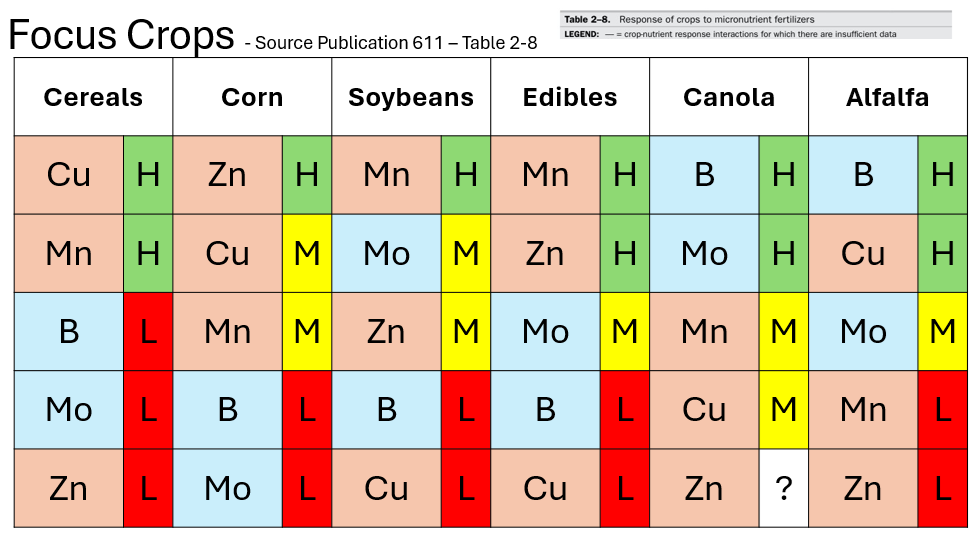
The keys to understanding micronutrient use in crops, is figuring which ones the crop in question is responsive to, if the soil can supply it, and what the crop stage/rate the nutrient deficiency needs to be addressed by (soil and/or foliar). If you can answer these four questions, you are in a good position to make a solid recommendation.
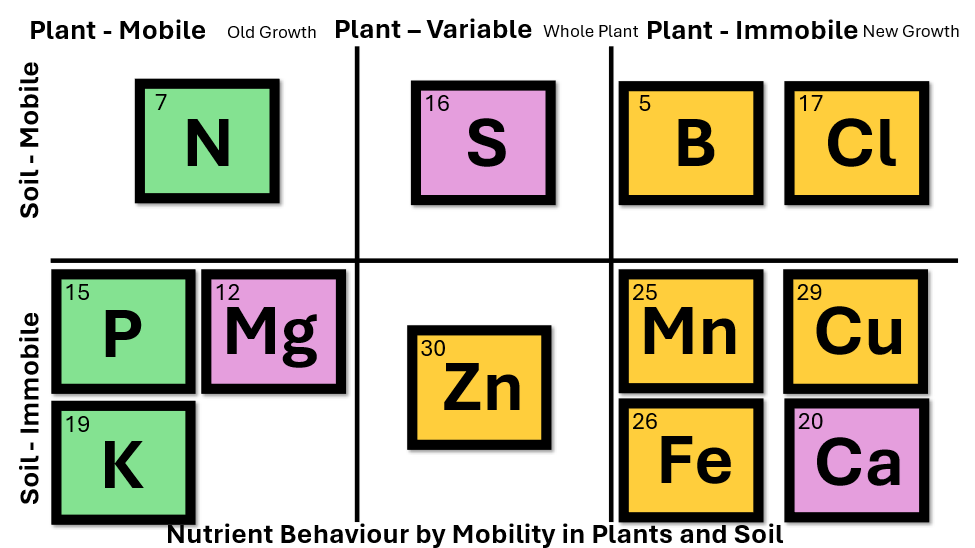
This chart is from publication 611 as far as nutrient response by crop. The blue are nutrients that are water soluble and should be applied to the soil with nitrogen for root uptake. The nutrients in brown are taken up by root interception and should be applied in a starter if moderately deficient, starter and broadcast if very low levels are in the soil. In some instances, the nutrient has availability issues even if it is present in the soil, in those cases a foliar application is required. Repeated foliar applications will be required on new growth (i.e. Manganese) if the soil is unable to provide and the nutrient is not mobile in the plant.
Boron Recommendations (JZ)
I was asked which crops are most responsive to the use of boron. This is a two-part answer. 1) The crop type determines the demand side of the equation, I would rate alfalfa/canola/potatoes as the most responsive, followed by corn, then soybeans then cereals as last. 2) The second is, what can the soil supply, what has been the past management? If no boron has been applied, you are on sandy soils and have had a high number of crops responsive to boron, you are more likely to see a very high response vs no boron responsive crops, on heavier soil types and have used boron periodically in the crop rotation. Even though boron is a water-soluble nutrient, it will accumulate in crop residues over time and build some of the soil supply if you have been using at some point in the crop rotation, focus on placing it ahead of the most responsive crop.
When should I apply it? My recommendation is to use boron on your first nitrogen application for the season, this gets the nutrient into the root zone to ensure you have adequate supplies throughout the growing season. Supplement with a foliar application at key timings, but do not expect this to be a silver bullet. Lastly, be very cautious using boron in starter applications, especially if directly applied to seed, it can be a sterilant.
PJL - For alfalfa it should be applied in the fall
JZ - I have had great luck apply boron in the spring on alfalfa with AMS, but fall boron may help with winter survival if you are not making spring application.
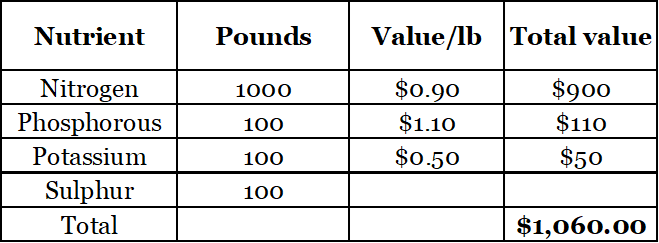
More on Manure (PJL)
Last week I put in a chart showing the value of manures. One reader called and said “Patrick, I think you are wrong. I think you are under valuing manure. We run about 3,000 acres of corn, soybeans, wheat and forages. We apply hog manure at about 5,000 gallons per acre and dairy manure at 10,000 gallons per acre. The only fertilizer we buy is nitrogen. Our corn, forage and soybean yields are above average for our area. Our wheat yields could be better. It may be our drill.”
I replied that I gave those numbers as an example and to encourage farmers to have their manure tested. The grower said, “we always have our manure tested.” I went back to the tables and pulled out some of the higher testing manure values. From these tables this is what this reader may have been applying
Hog manure testing 18-30 pounds of available nitrogen, 13 pounds of available Phosphorous and 28 pounds of available potassium. Applying this manure at 5,000 gallons per acre has a value of $222.50 - $276.50 per acre.
The dairy manure could have 9-16 lbs available N, 13 lbs available P and 28 lbs available K. Total value at 10,000 gallons per acre could be $288.50 - $351.50.
Q Last year, I applied fertilizer based on crop removal guidelines. My corn and soybean yields were about 50-60% of average due to dry weather. Can I reduce my fertilizer rate on those fields for 2026?
Ans (PJL)
Yes, you can. Consider it as you would broadcasting enough fertilizer for two crops. Calculate how much it came off with the reduced crop yield, subtract that amount from what you applied and the remaining will be available for this year’s crop.
Value of Organic Matter (PJL)
I was asked what the nutrient value of organic matter is. The issue is trying to unlock the nitrogen portion or at least predict when it will become available. The answer involves both soil temperature and moisture. We won’t be able to predict when it will become available until we have better weather prediction models. The other issue is the type of organic matter. Not all organic matter is equal. Research suggests that there are three types of OM. OM that was formed in the last 10 years, OM formed from 10-30 years ago and older organic matter 30 years+. I believe (but have not research to back it up) that in the last 10 years we are increasing the amount of crop residue that is being added to the soil. This extra crop residue is from higher corn yields, more cover crops, and less tillage. This residue is not factored into organic matter tests. It won’t be for maybe another 10 years before we see this extra crop residue being measured as organic matter.
Business Matters
Signs that a Product is a “Snake Oil”! (written by my acquaintance Darel Walker CCA Indiana)
Some things never change. Whenever crop economics get tough, the “Snake Oils” come out of the woodwork! This is my guide to identifying snake oil. It may be a snake oil if:
1) It has a catchy name like “Croptimizer”.
2) It has little nutrient value in a liquid formulation, less than 10% of any known nutrient.
3) The studies show a 7 BPA yield increase! It is always 7 BPA!
4) It has a dubious mode of action.
5) The salesperson says, “A gallon of this will replace P, K, and Nitrogen.” This is what I call the “Big Lie”.
6) It comes from a non-traditional source, such as some guy’s garage.
7) You have a 1-2 Qt use rate.
I have already had a few calls on these this winter. If you have someone pushing a new product and want an unbiased opinion, give me a call, or email me the product label and I will gladly check it out for you. There are many legitimate non-traditional products, and many are now commonly sold by retailers.
(I will add that if the seller does not live in your area, it might be snake oil) (PJL)
Jonathan or I will also agree to check some products you are interested in.)
Using soil moisture probes to make in-season management decisions (JZ)
Notes from a presentation given by Guy Ash, Metos North America on how to read soil probe moisture data. Soil moisture probes will provide a better indication of soil texture than a soil map will. It will measure the soils field capacity and wilting point. With this data you can calibrate a refill point on when you should irrigate, or when the plant will start to experience moisture stress. Additional data that can be collected by a soil moisture probe includes temperature and salinity. Salinity can provide an indication if nutrients are moving up or down within the soil profile. How do I use this information? Figuring out optimal planting, understanding how fast plants are growing/dormancy, timing of in-season applications, figuring out if you are at risk of loss/estimating nutrient availability (affected by both temperature and soil moisture).
Archives
From our Archives 10 years ago The Buzz About Boron – (Jonathan Zettler)
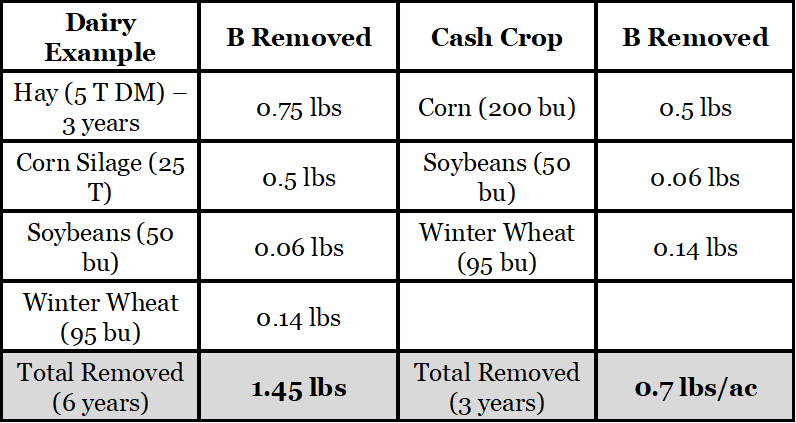
Boron has been a popular topic this winter. Should you be using boron? That depends. If you have alfalfa in the rotation, I suggest you should seriously consider it. Here are two examples of crop rotation showing boron removal. Soybeans take up a lot of boron, but most is left in the residue. Some soils (light) are more prone to B leaching. Every crop removes B. At some point you will have to start replacing B.
Courage is the first of human qualities because it is the quality which guarantees the others.
— Aristotle