
The Cropwalker - Volume 9 Issue 7

By Jonathan Zettler CPA, CMA, CCA-ON and Patrick Lynch CCA-ON
ALWAYS READ AND FOLLOW LABEL DIRECTIONS
CONFIDENTIAL NOT FOR PUBLICATION
Send us your questions
If you have a question, just reply to this email, we try to have an answer for you within 48 hrs. Or text Jonathan at 519 323 7505 or Patrick at 519 275 1058. If you want a topic researched let us know.
Unable to see pictures? Move this email to your inbox or ask your email app to download them. Usually at the top of the email in a header.
Things to do This Week
Time to Spread Red Clover (PJL)
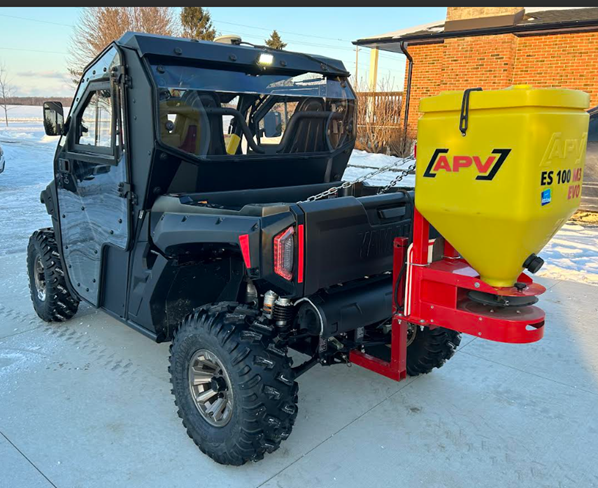
March 1 is the official opening of “Red Clover Seeding Season”. As soon as the ground is fit, consider spreading red clover. Ryan Benjamins CCA-ON in Lambton County sent a picture of his new red clover spreading machine. He has started this week. Ryan shared red clover seeding dates of one of his customers over the last 20+ years. The earliest they started was January 26. The latest they started was March 30. Over the 20+ years the average start date was March 4 and average finish date was April 15.
Red clover has about 275,000 seeds/lb. (coated seed will have fewer seeds per pound). This equates to 6.3 seeds per square foot per pound of seed. At 7-8lb/ac, you are seeding 45-50 seeds per square foot. At 85% germination, there is 38-42-seeds/sq ft. If only 50% of these grow, you over 18-20 plants/sq ft. Higher seeding rates compensate for uneven seed spread. Don’t worry if there is a bit of snow still in the field. Ryan says “either you get a good stand, or you don’t. I do not think moving to 10 lbs. makes much difference. I have seen good stands at 5 lbs./ac.” Ohio research interestingly shows that nitrogen from red clover is released the following year when corn is starting its maximum nitrogen uptake.
Cereals
Frost seeding spring cereals [PJL]
Notes from former University of Guelph researcher Dr Bill Deen
1. You must have your machinery ready to go and are willing to be up at 2:00am,
then plant from 3:00am until it gets too greasy. With one fill-up of the air-seeder,
we can plant 70 to 80 acres each night!
2. It is best when the winter frost is out of the ground, then a light spring frost:
just enough frost on top to carry the machinery for a single pass only. Our
single disc openers can make a half inch furrow for the seed, which will cover
back in after the next snow or frost.
3. Frost seeding is not as hard on machinery as dry soil.
4. Frost seeded spring wheat will flower before the worst of the summer heat and matures
10 to 15 days after winter wheat, so this spreads our harvest workload.
5. Frost seeded spring wheat needs to be in early: March 25 to April 25 is good, and
we cannot plant other crops then anyway. If there are still snow drifts along
a hedgerow, we plant around them and put something else there later. Starter P fertilizer is needed: we use 11-52-0 MAP.
JZ – you can do the same practice with barley or oats.
#47 Record Breaking Wheat Joanna Follings continued from last week (PJL)
Last week’s graphs showed.
1. average rate of nitrogen was 20-29 lbs. in the fall and 120-130 actual N in the spring. Total 140-150 lbs. N/ac for the whole season.
2. About 50% of the growers used a Plant Growth Regulator (PGR)
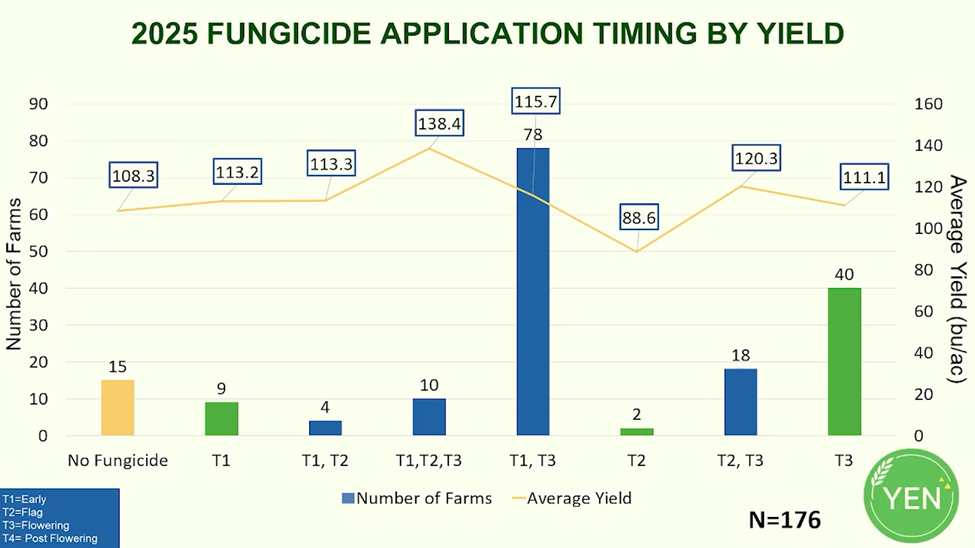
3. The fungicide use shows highest yields were from 3 applications but the most common pattern was a T1 and T3 timing
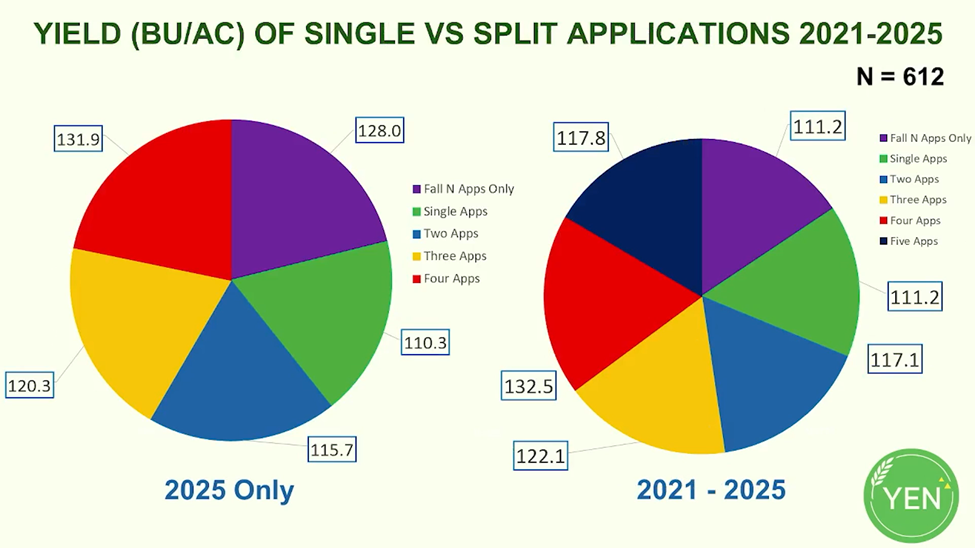
4. It appears that four applications of nitrogen was better than three which was better than two applications. In each case the fall application is timing one. (I wonder if the growers who were making 3 and 4 applications were tending to do everything else with more precision. )
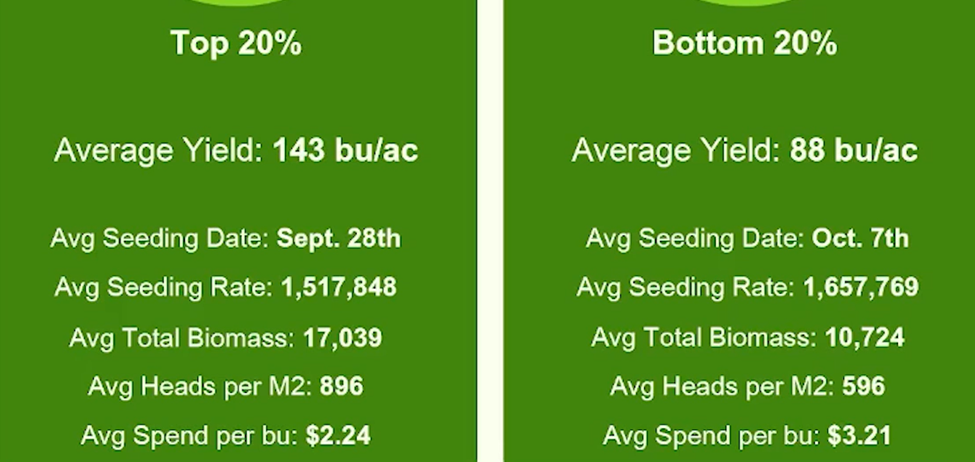
5. This slide says a lot. Probably biggest thing is that earlier planting yielded the most wheat. Earlier planting, more biomass, higher yield. Remember this when picking a soybean variety for your wheat fields.
Weed Control
Grass Herbicides in Soybeans (JZ)
There are 6 grass pre-emerge herbicides registered in Ontario, these are;
dimethenamid-p (Frontier)
imazethapyr (Pursuit)
s-metolachlor (Dual/Komodo/Boundary/Strim MTZ)
pendimethalin (Prowl)
pyroxasulfone (Zidua/co-formulated in Focus/Authority Supreme/Fierce)
trifluralin (Rival/Treflan)
Some pointers
· Many fields will have some degree of resistance to the imazethapyr – group 2 herbicide.
· Trifluralin will break down in sunlight and requires incorporation within 24 hours
· Pendimethalin will provide similar weed control characteristics to trifluralin but does not need to be incorporated, however it must be applied prior to planting soybeans.
· dimethenamid-p/ s-metolachlor/ pyroxasulfone control similar weed species but pyroxasulfone is sharper on bluegrass and waterhemp.
· Pyroxasulfone is more persistent in the soil and requires more water to activate than dimethenamid-p or s-metolachlor, as a result it is also more sensitive to soil disturbance.
How do they sort out when it comes to common grass issues? See list below. I did not account for herbicide resistance when running the chart.
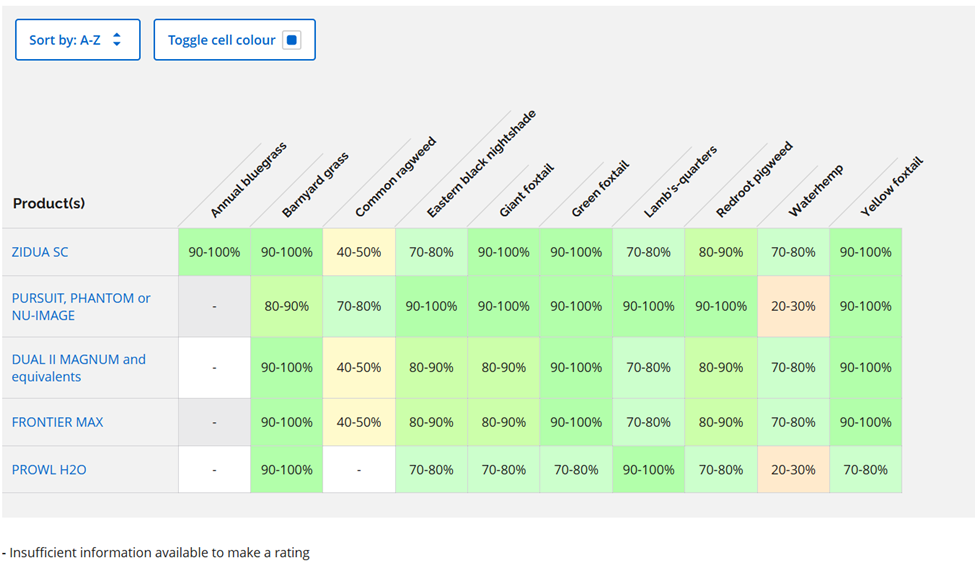
Pre-Emerge Options in Soybeans? (JZ)
Which product you pick depends on yield/quality impact of the weed spectrum you are working with and the ability to control escapes in crop. For IP soybeans, growers tend to want to spend more $$ on pre-emerge due to limited options in crop for control, especially around fleabane, pigweed species (pigweed/waterhemp/palmer), lamb’s quarters and ragweed. For this reason, most IP soybean programs are now built around a grass product plus either metribuzin + Authority or metribuzin + Valtera to try and stay ahead of these broadleaf weeds.
For the herbicide traited acre, tillage system and weed pressure become of more consideration on selection. Typically, metribuzin (Sencor/Tricor) is the base to manage fleabane with grass or broadleaf weed control added as required. If reduced tillage, usually this is a phenoxy with glyphosate (dicamba or Enlist as per herbicide system). If tillage, perhaps a pre-emerge “lite” program i.e., Boundary or Strim MTZ, or an early post program with some residual (i.e., glyphosate + phenoxy + Zidua).
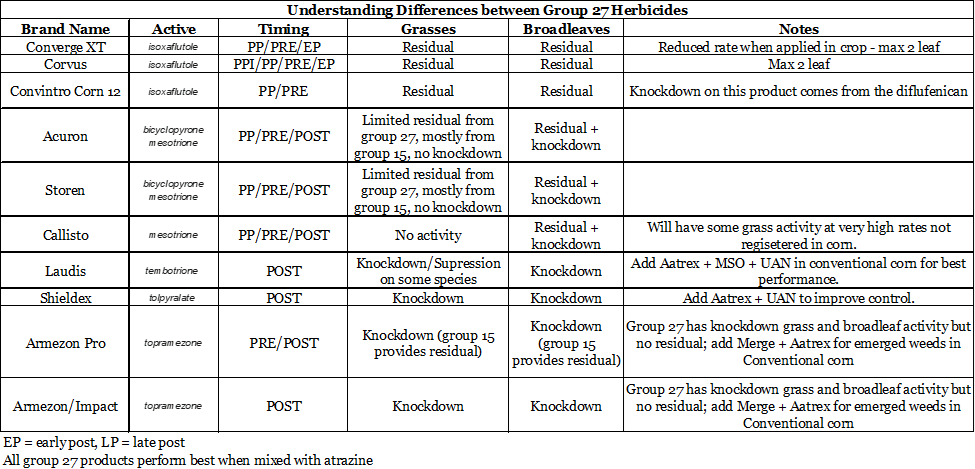
Group 27 Herbicides in Corn – Review (JZ)
Some have activity on grasses; all have activity on broadleaves. Some have residual, some have post emerge control. Some have both. This chart is a summary.
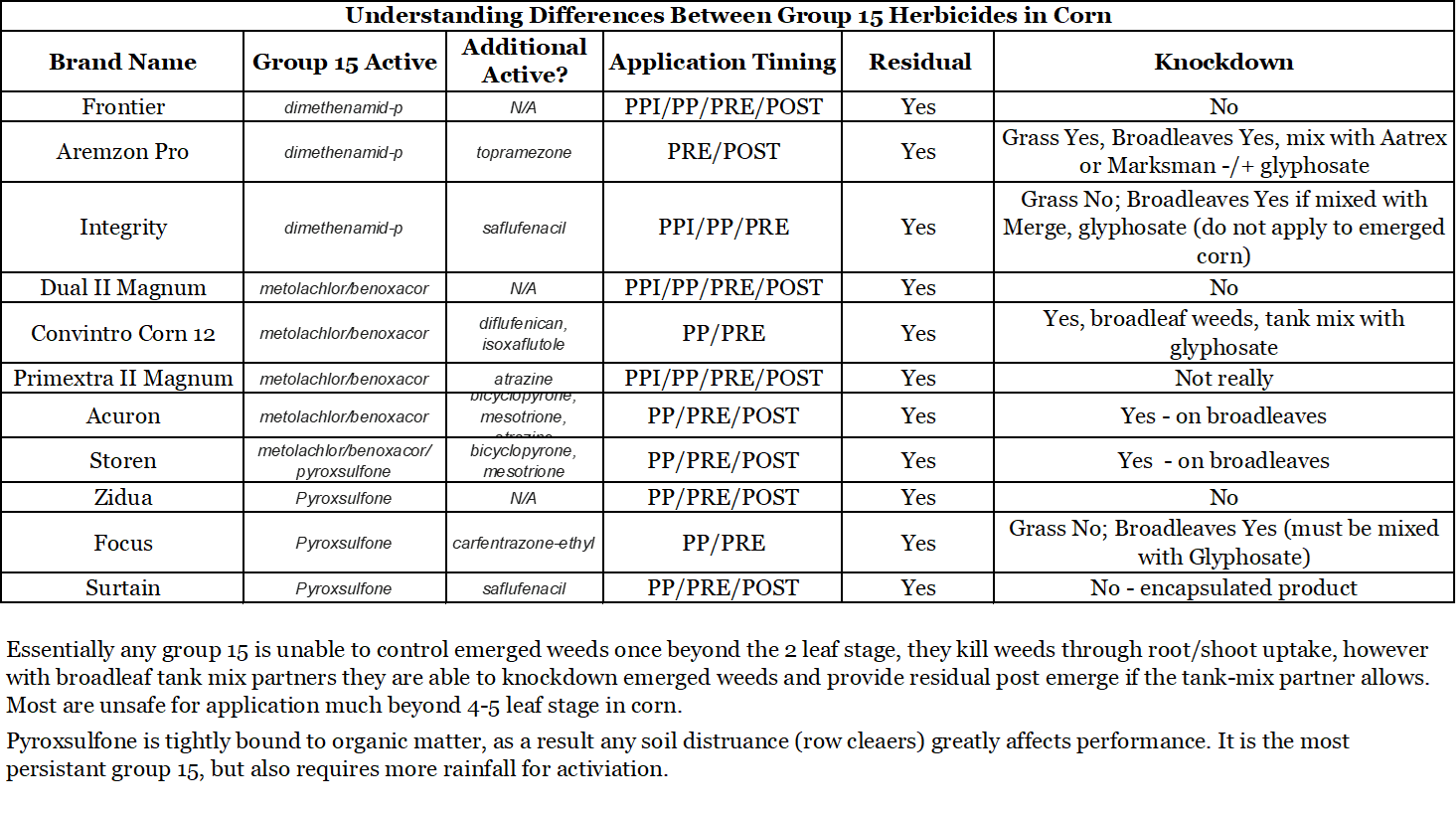
Group 15 Herbicides in Corn – Review (JZ)
There are, three group 15 herbicides that are registered for use in corn in Ontario. This is a summary of the herbicides that contain them and the registered timings.
Strip-till Corn Herbicide Options (JZ)
Essentially no options that can be applied ahead of strip-tilling and maintain good weed control in the strip. If doing a shallow refresh, you could look at products registered both for PPI/PRE, however they are unlikely to take down glyphosate resistant weeds (outside of Eragon or Integrity). As result your best bet is typically to do an herbicide application after the strips are made (i.e., Mesotrione based products) or the corn is planted (dicamba based products) but before it emerges to limit weed interference.
Lontrel could be used pre-tillage and be safe for the corn but is currently not registered for this use pattern. Do not incorporate or apply dicamba prior to planting corn.
PJL - Jonathan the inference is to apply dicamba before corn has emerged. I would never do that based on my experience.
Rob Miller, BASF comments – We use dicamba or Marksman pre-emerge on many acres without concern. Watch outs are shallow planted corn, risk of heavy rain events after application, and/or with sandy soil types (i.e. less than 2.5% OM), you may want to move dicamba use until corn has emerged. Definitely do not recommend Pre-Plant Incorporated or Pre-Plant.
Forages
#12 SWAC Successful Winter Cereals for Forages (PJL)
Two dairy farmers from eastern Ontario (Roy Hofuis and Martin Schoulen) spoke about their experiences growing winter cereals for forages.
They both tried cereal rye and winter triticale, but now they grow mostly cereal rye. Cereal rye seed is less expensive but triticale is more responsive. They can push triticale with nitrogen to increase protein and do not have to worry about it lodging with high N rates. Cereal rye will lodge with high N rates. They typically seed 90-100 lbs./ac and apply nitrogen in the fall. Then in the spring apply 140 N to get higher protein with sulphur. They typically harvest at least 3 T /ac of dry matter. There is no weeds in the triticale.
Snow mould is an issue. They are anxious to see if the sulphur trials Joanna Follings of OMAFA has in northern Ontario, will reduce snow mould. They are skeptical. (Ed I am also skeptical. I would like to see various fungicides applied to triticale in the fall before freeze up but after there is significant fall growth)
They mentioned that harvesting is challenging. They have a longer window to harvest with triticale than with cereal rye. They do not believe you can “harvest in a day”. They cut today, ted tomorrow and hope to harvest the next day. They mentioned that having that much triticale lying on the ground is very hard to field dry. They will merge the field before harvesting.
Frost Seeding Pastures Broadcast-seeding legumes (clovers and trefoil) (PJL) into established pastures in late winter or early spring can be an effective way of increasing the legume content in a pasture stand. Broadcast the seed when the ground is still frozen. The freeze thaw action of early spring will help the seeds establish good soil contact. Pastures should be aggressively grazed the previous fall to reduce the competition from the established perennial species in the pasture. Alfalfa and most grass species generally have low to very low success rates when frost seeded. (OMAFA Agronomy Guide)
Spring N Requirements on Winter Triticale (JZ)
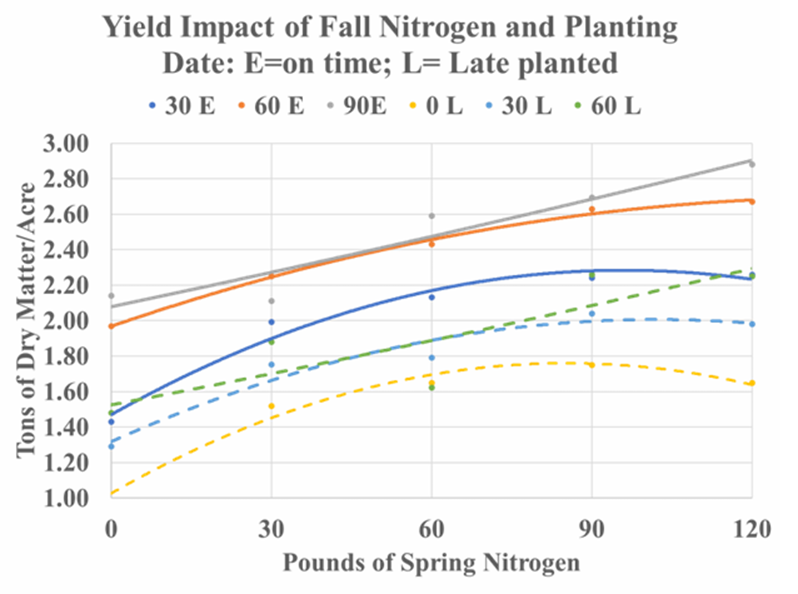
Tom Kilcer had shared this chart as a graph a number of years ago. The N rate require varies by planting date relative to fall nitrogen application. I’ve summarized it as a chart to make it easier to determine the proper application rate.
Notes
1. Do not use manure in the spring as a N source
2. Fall N increases spring yields by 20-30%.
3. Fall N only works if the crop is planted on time (plants need to be big enough to accumulate N).
4. If planted late, use 30 lbs. N in the fall.
5. Planting on time with fall nitrogen, at the same spring nitrogen rate means a 60% increase in yield the next spring vs not doing those two things (planting late and no fall N).
Fertility
Myths about phosphorus (taken from an article on The Anderson’s web site)
· MYTH: Orthophosphate is better than polyphosphate because it is in the plant available form.
· Polyphosphate ions are readily converted to orthophosphate ions in the presence of soil moisture. If the soil temperatures are normal the conversion can be completed in days with normal soil temp. Trials done show that fertilizer applied in the different forms clearly show that a pound of P is a pound of P.
· MYTH: Liquid Phosphate is more mobile in the soil.
· Phosphate will not move very far at all in the soil regardless of fertilizer form (liquid or granular.)
· MYTH: Liquid Phosphate is available throughout the entire growing season.
· Phosphate fertilizer in any form can get tied up quickly. Only 10-30% of applied phosphate fertilizer is available during the season it was applied in. It is important to remember that seed placed P fertilizer will always be more efficiently available compared to any broadcast that is spread on the field.
· Mainly a MYTH: Elemental Sulfur acidifies the soil and frees up phosphate for the plant.
· While it is true that elemental sulfur can acidify the soil or acidify a part of the soil locally, it has not been proven to be effective for improving phosphate availability.
N Loss and Nitrogen (JZ)
There are five types of nitrogen on the farm.
Organic Matter/Organic (soil/manure/compost) – losses are primarily from erosion
Urea (CONH2)2– manure/commercial fertilizer – water soluble nitrogen in a stable form. Some risk of leaching on coarse textured soils.
Ammonia (NH3)– manure/commercial fertilizer – this is the most volatile and will gas off unless it is captured in water vapour until bacteria can convert it to the ammonium form. The main active that prevents volatilization is NBPT, by delaying the conversion of Urea to ammonia.
Ammonium (NH4)– stable form tied to organic matter/clay particles
Nitrate (NO3) – this is a water-soluble form that can be reactive in low oxygen environments. It is at risk of denitrification (lack of oxygen) or leaching (washed below the root zone) in coarse textured soils. Main active that prevents denitrification is DCD by delaying the conversion of ammonium to nitrate.
Is a pound of Sulphur, a pound of Sulphur? (JZ)
No. The plant needs to have it available when it enters rapid growth. The elemental form (manure, some types of fertilizer), may not be available to crops that have a base temperature of 0 vs those with a base temperature of 10 depending on when the key response time is.
i.e., Coarse textured soils have limited capacity to provide early season S.
1.In soybeans, early planting is more responsive to sulphur application on coarse textured soils due to the effect of increasing successful nodulation. Later planting sees less effect due to more available sulphur within the soil once temperatures warm up.
2. In winter cereals the plant starts rapid growth before temperatures reach 10 C to mineralize sulphur, as a result they respond to sulphate sulphur early in the season when entering the rapid growth phase.
Precision Ag
Soil Optix vs SWAT Maps? – What is the difference between them? (JZ)
There are some fundamental differences between these two services. SoilOptix is a soil test layer with high density point data. The number of soil test layers varies by the service package you buy. The point data is generated by scanning four different types of radiation emitted from the soil and calibrated to a soil sample (about 1 every 8 acres).
SWAT Maps is an annual consulting service to manage the landscape driven field variability in the field through variable rate scripting for seed and crop nutrients.
Is one better than the other? I guess it depends on what you are trying to accomplish. While I am a SWAT service provider, there have been instances where I have promoted other soil sampling methods if I felt what I had to offer was not going to meet the customer’s needs. At some point you have to pick a lane and realize even in the soil sampling world it can be like “John Deere vs Case IH” when it comes to offering services.
There are some also philosophical differences between the two product offerings. I have found that Soil Optix providers tend to focus on getting all nutrients in “balance” or removing field variability. SWAT Maps tends to look at seed/nutrients response based on landscape variability and adjusting rates to suit response those areas.
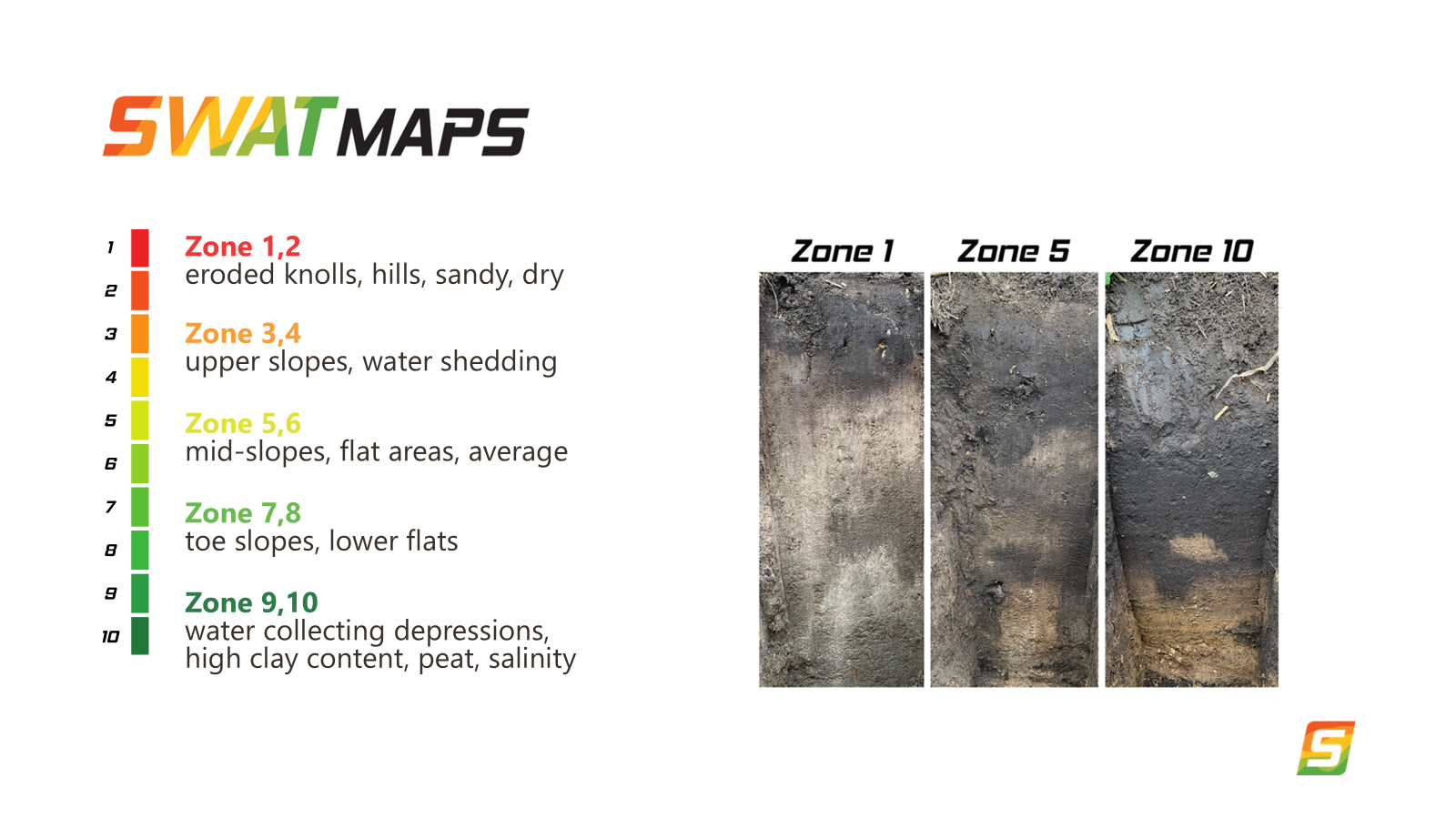
Why does SWAT Maps have 10 zones, why not adjust the number of zones by field? (JZ)
Within the SWAT Map system, zones are characterized to topographical features. These features are common to all fields, as a result you are indexing these features (landscape position) to the field. You then have a common language to characterize field to field behavior. The absolute behavior or nutrient response of these zones will vary from field to field, but the general underlying idea will remain the same when it comes to soil erosion, water movement and nutrient release.
If you do not have a common language within your zoning system (i.e., one field has 3 zones, the next has 5, and the third has 7 because of differences in variability), how will you know what the zones mean? Tying the zone behavior to crop input response is key to a successful digital (precision) ag program.
If you are not planning to address field variability through crop input response i.e., measuring and adjusting your flat or variable rate, in the near future, the use of SWAT Maps will be of limited benefit to your farm operation.
Nothing exists except atoms and empty space; everything else is just opinion.
— Democritus