
The Cropwalker - Volume 9 Issue 9

By Jonathan Zettler CPA, CMA, CCA-ON and Patrick Lynch CCA-ON
ALWAYS READ AND FOLLOW LABEL DIRECTIONS
CONFIDENTIAL NOT FOR PUBLICATION
Send us your questions
If you have a question, just reply to this email, we try to have an answer for you within 48 hrs. Or text Jonathan at 519 323 7505 or Patrick at 519 275 1058. If you want a topic researched let us know.
Unable to see pictures? Move this email to your inbox or ask your email app to download them. Usually at the top of the email in a header.
Things to do This Week
1 Review grain marketing plan. Recent events have affected prices.
2 Check wheat for winter kill and eroded areas and decide remedial measures. What is your plan B?
3 While checking wheat, see what weeds are present. Winter annuals and perennials will determine herbicide choice.
4 Check for tile blow outs.
5 Check lane ways and fence rows for downed trees and limbs. Winter ice storms have knocked down significant amounts of tree branches in some areas.
6 All spring seeding equipment should be ready to go.
7 If you plan to harvest corn stalks, decide which fields.
Cereals
How much sulphur does my wheat crop need? (JZ)
At a minimum I would apply 20 lbs. actual S/ac per acre. Any trials we had for 2024 on S rates did not show a response over 20 lbs./ac. In 2025, we found fall MESZ seemed to give a response for customers using ATS as the spring sulphur, for those running AMS as the first pass, there was a slight advantage to using MESZ in some fields, not in others. Preference is for Ammonium Sulphate applications in a single pass on the first application. If you are interested in running a rate trial and are willing to share the data, let me (Jonathan) know, and we can put together check blocks/scripts. Preference is customers using a cloud-based system for capture as applied and yield data (SMS Agfinity/ JD Ops Centre/Fieldview/CNH FieldOps).
What is in a cereal plant growth regulator? (JZ)
There are three plant growth regulators registered in Ontario. Ethrel, Manipulator and Moddus. Bayer hasn’t been promoting Ethrel for several years, so I won’t spend much time on it and will focus on Manipulator and Moddus. All of these products are trying to stiffen the stem of the plant at a key crop stage. Usually in the stem elongation/jointing stage (Z30 stem elongation to 37 early flag leaf – optimal is 1st to 2nd node).
The exact mechanism depends on the product being used, however in layman’s terms, both work to reduce the amount of gibberellic acid (GA) activity. High N rates increases the amount of GA activity, causing cell elongation to happen faster than stem wall thickening.
A literature review suggests that Manipulator may be more beneficial at earlier rather than later applications, and the main target site involved earlier in the GA pathway. Whereas Moddus may have more activity on multiple internodes and more activity when higher N rates are used.
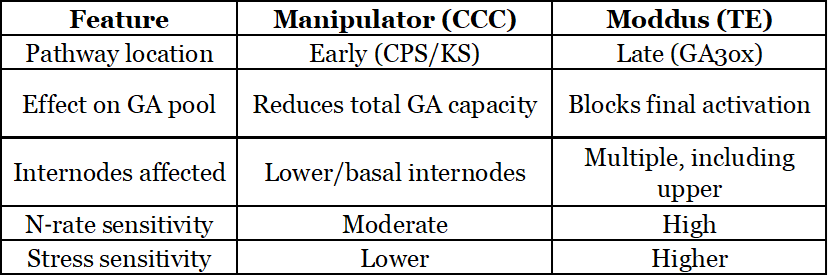
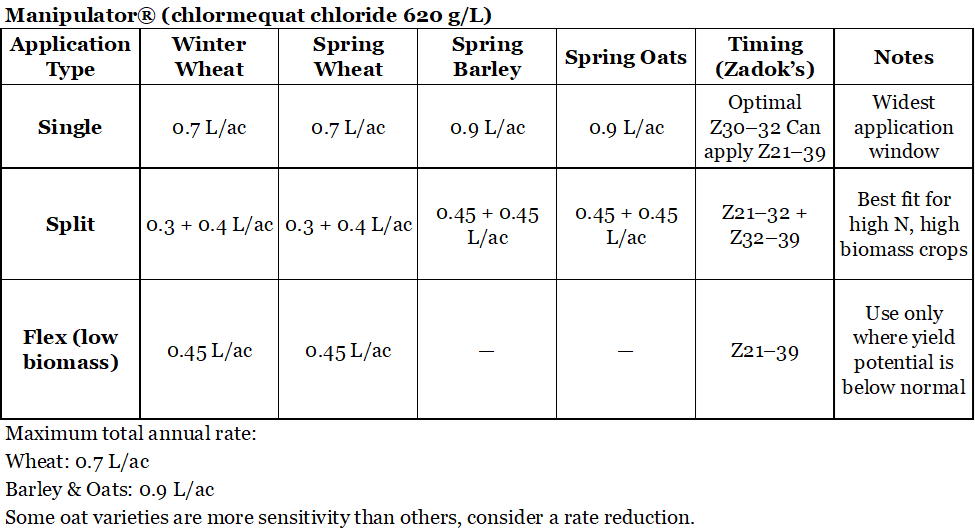
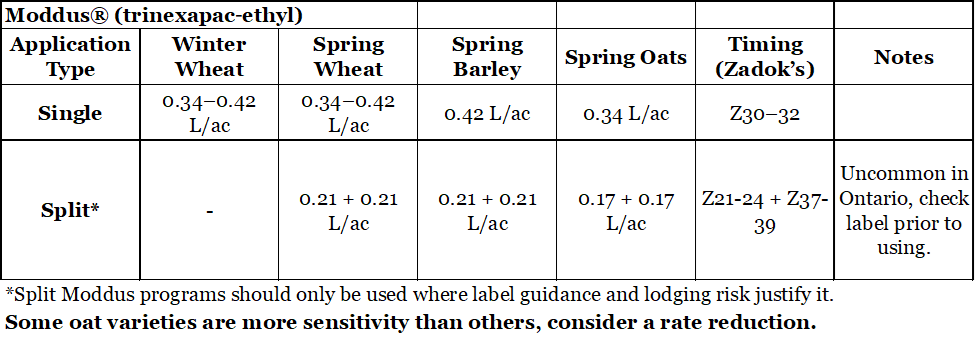
While I have used both products, I have found that Moddus seems to make its way into more of my crop plans than Manipulator.
Weed Control
Tillage for weed control (PJL)
Is different than tillage for seed bed preparation. For seed bed preparation, tillage can leave trash on top, if you have good row cleaners. We used to use tillage for weed control. We did this by working at least 3 times before planting. If you are using tillage for weed control, all green weed tissue must be buried, if any green is showing those weeds will regrow. Spring tillage can effectively control small annuals or winter annuals coming from seed but will not control established winter annuals or perennials unless they are completely buried and even then, some will regrow. If you are planning to use tillage as part of your weed control program, then spraying early with 0.5 L glyphosate 540 will help control annual grass and broadleaf weeds.
Can I spray Infinity twice on winter wheat? (JZ)
You can spray Infinity in the fall on winter wheat and again in the spring, however you can spray Infinity FX only once per growing season, either in the fall or in the spring.
Can I use the fungicide Tebuconazole (Orius/Folicur/Tebbie) with my wheat herbicide program? (JZ)
Based on a conversation I had with Drew Thompson of Adama, I would suggest avoiding any mixing of this active with herbicides. When mixed with hotter herbicides, especially those containing bromoxynil i.e. Pardner, Buctril M, Infinity, Infinity FX, you can have severe crop damage under stressful conditions i.e. frost event or hot/humid weather. Drew suggested using another fungicide for the T1 application in cereals.
Volunteer Corn Control Reminder (JZ)
If are working on putting together your 2026 herbicide program, this a is a reminder that if you grew Enlist traited or Pioneer corn in 2025, you will need to use clethodim, not quizalofop-p-ethyl (Yuma/Assure/Marshall etc.) to control volunteer corn in your 2026 soybean and edible bean fields. Clethodim based products tends to not mix as well with broadleaf herbicides as quizalofop-p-ethyl based products.
Corn
20 vs 30” corn (JZ)
Had a few conversations this winter on 20” vs 30” corn. Few things to consider operationally.
Pros
Historical university research suggested a yield advantage of 4-7% depending on the production system.
Could use one planter for corn/soybeans – do 20” corn, then go between the corn rows
Cons
Higher per acre equipment cost, more row units and corn head snouts to maintain. If something breaks or are behind not just anyone can come "help".
Reduced tillage programs like strip till may not make sense
In-season management (spraying/fertilizer) could be tricky without special tires/spacing?
If trying to run dry fertilizer coulters/row cleaners/row unit, it needs more frame weight to keep the planter in the ground.
Will higher seeding rates typically required to maximize the yield advantage. Precision Planting data suggests 36-40,000 seeds/ac.
I know of few making 20” corn work. Where there is a will there is a way.
Q – Jonathan, why does my variable rate corn scripts not work when I write them, but the seem to work when you write them? (JZ)
A – The key piece to making variable rate corn seeding scripts work is 1) understanding the corn genetics you are working with, and 2) having a good map that represents the stresses within the field that we need to adjust the rates for.
If you do not understand the populations curves and how the plant makes yield, unfournately you are not likely to have consistent results with your seed scripts. We are playing a game of inches when it comes to variable rate seeding. I have learned that it is much more nuanced than I would like when it comes to seed scripting. The idea behind seed scripting is that the rates are maximized until something breaks (either agronomically or economically), take that to the zone level on a field-by-field basis. Even the scripts I have written tend not to work if the customer switched out the corn hybrid, not realizing the impact. Attention to the details is key in making VR or Optimal Rate seed work.
Forages
Forage seeding reminders (PJL)
An article written years ago by Marvin Hall, Penn State Forage Specialist, “more failures in establishing forages are the result of improper seeding depth than of any other cause. If seeding depth is not correct you might as well not bother to plant. Forage seeds have a very small supply of stored energy to support the seedling until they emerge and begins making its own energy. Seeds placed too deep are not likely to emerge. Optimum seeding depth varies with soil type but generally is not more than 3/8” deep. A rule-of-thumb is that “5-10% of forage seeds planted should be on the surface after seeding.”
Other reminders
1. Phosphorous placed under the seed improves seedling establishment. (JZ – I like to apply 150-200 lbs. of MAP or MESZ in the seeding year)
2. An aggressive nurse crop that contains peas can smother out new seeding unless the nurse crop is harvested early i.e. at boot stage.
3. Using a nurse crop of oats reduces weed competition.
4. There is no herbicide registered to take out broadleaf weeds from an alfalfa crop seeded with peas.
5. Cereal nurse crops should be seeded at about 50% of normal cereal crop seeding rates and harvested at the boot stage.
Another Triticale Setback (PJL)
Have another field of winter triticale in Oxford County area that is 95% dead from snow mould. We are trying to put together scenarios that is causing this. So far it seems that early planted stands had a lot of top growth suffered the worst. Growers want high yields so plant early to get top growth. But until we can find a solution for snow mould maybe early planting is not such a good idea. Seed was treated for this field.
Harvest time for triticale (Notes from Tom Kilcer noted triticale guru from New York)
Harvest: DO NOT HARVEST AT BOOT STAGE. This is about a week late and significantly decreases the digestibility and milk produced. It was OK in the 1980’s when 60 lbs. of milk/cow/day was considered good. Today, 90 lbs./cow/day is considered normal, and the digestibility of the forage is critical both for supporting the healthier, more profitable, high forage diets and the amount of milk the cows are producing. This earlier, on-time harvest will slightly decrease yield, but will significantly increase the amount of milk from every pound of forage. The optimum stage of winter forage harvest is Feekes stage 9 (Zadok’s 39), where the flag leaf has unfolded, but the head has not emerged yet. Preliminary data indicate that if temperatures are cool to cold, the forage quality (milk producing ability) could hold into early head. Traditional boot stage (10) is too late for top production from high forage diets.
Fertility
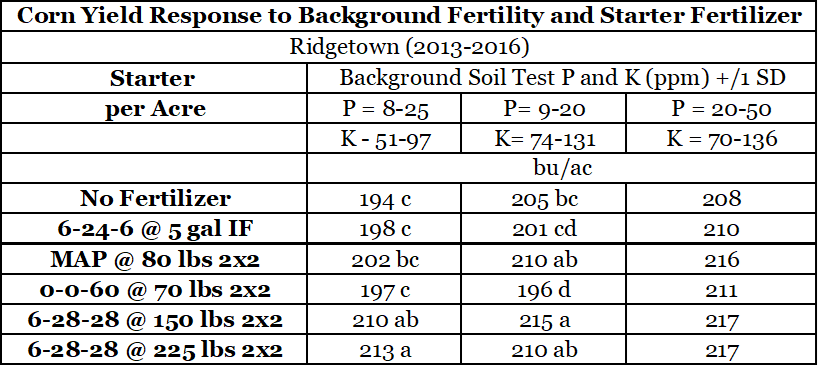
Q I have a grower who is thinking about not using a corn starter fertilizer to save money this year. What do you think?
Ans (PJL) This question comes up every year. The table below shows that starter fertilizer pays on low or high testing soils. The research shows about 4-5% yield increase with a starter. I like the 50 lbs./ac MAP scenario. But I would change that to 50 lbs./ac MESZ which has zinc and sulphur.
Business Matters
Using Weather Data for Spraying - Delta T vs Vapour Pressure Deficit (JZ)
Delta T and Vapour Pressure Deficit (VPD) are closely related concepts, but they are used differently and expressed in different ways.
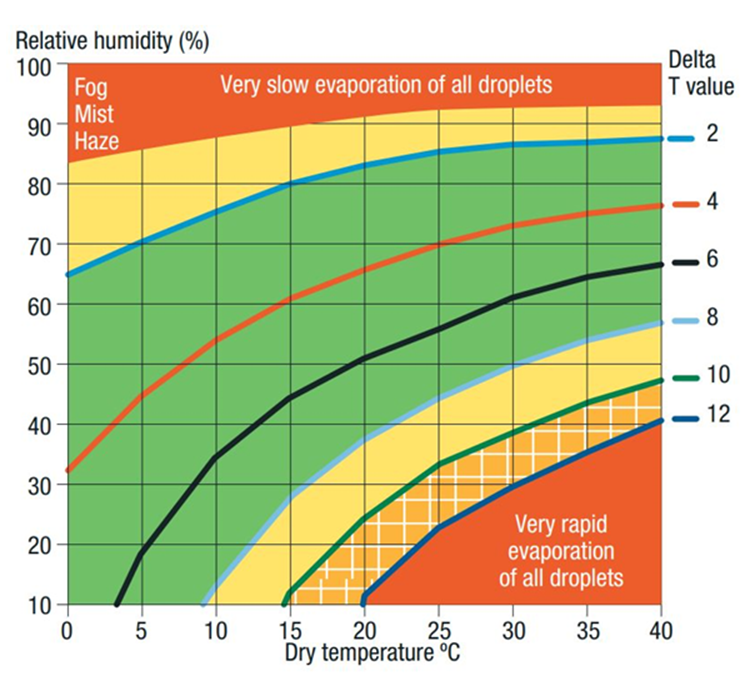
Delta T is a simplified index based on air temperature and relative humidity. It represents the difference between dry-bulb and wet-bulb temperature and is mainly used in spray application decision‑making. Because it is expressed as a single number with practical thresholds, Delta T is easy to interpret in the field. Applicators use it to judge evaporation risk and droplet behaviour, with a common target range of 2–8 for effective spraying. Below Delta T of 2 risks run-off of the material, as the humidity is too high. High Delta T risks the plants evaporating before the have a chance to hit or enter the leaf.
Vapour Pressure Deficit (VPD) is a more scientific measure of the drying power of the air. It is calculated as the difference between the amount of moisture the air can hold at saturation and the amount it holds, and it is expressed in kilopascals (kPa). VPD is widely used in plant physiology and agronomy to assess crop water stress, transpiration rates, and irrigation demand. VPD directly affects plant transpiration, stomatal opening, CO₂ uptake, nutrient transport, and overall plant stress. When VPD is too high (hot, dry air), transpiration can exceed root water uptake, causing stomatal closure, reduced photosynthesis, leaf curling, and potential heat injury. When VPD is too low (cool, humid air), transpiration is limited, leading to poor calcium transport, guttation, condensation on leaves, increased disease pressure, and fruit disorders such as cracking.
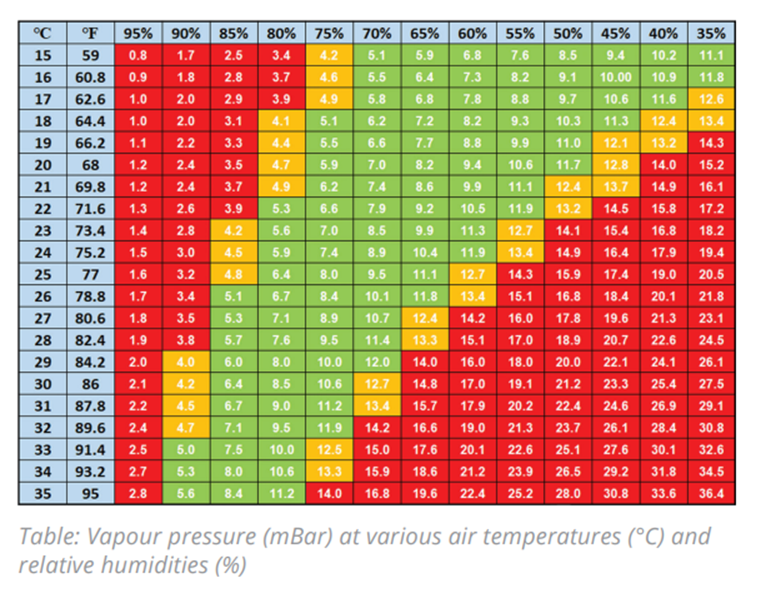
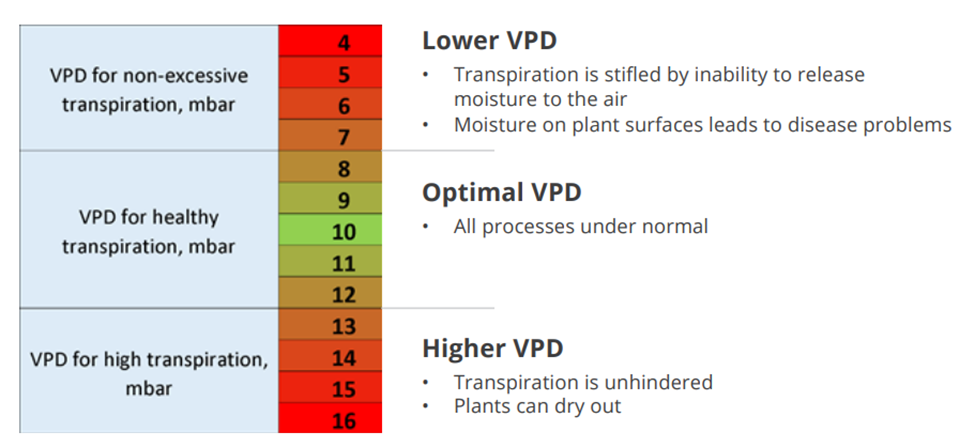
In short, Delta T is a practical spray-management tool, while VPD is a physiological and environmental metric. Both describe atmospheric moisture demand, but Delta T is optimized for operational decisions, whereas VPD is better suited for understanding crop responses to weather conditions.
No winter lasts forever; no spring skips its turn.
-Hal Borland